We occasionally share updates when important information changes or new long-form guides are published. Just practical updates related to long-term living in Surat Thani and Southern Thailand.
The decision to relocate a family to Southern Thailand often hinges on the quality and accessibility of educational infrastructure. For many years, the default choice for expatriates was the high cost environments of Phuket or Bangkok, where the international school market is heavily commercialized.
However, a significant demographic shift is occurring as families seek long term sustainability and authentic cultural integration. This shift has brought education in Surat Thani to the forefront of the conversation. Unlike the tourist centric islands, the mainland offers a landscape that requires a more nuanced understanding of local infrastructure and academic planning.
Surat Thani functions as a legitimate Thai city rather than a resort town. This distinction provides a more authentic experience than the expat bubbles of the nearby islands. The rise of bilingual schools in Surat Thani reflects a growing demand for a middle ground that balances global standards with local roots.
These institutions provide a critical service for families who prioritize school quality and safety while wanting their capital to go further. By choosing the mainland, families can access high quality instruction without the heavy luxury lifestyle premium found in more saturated markets.
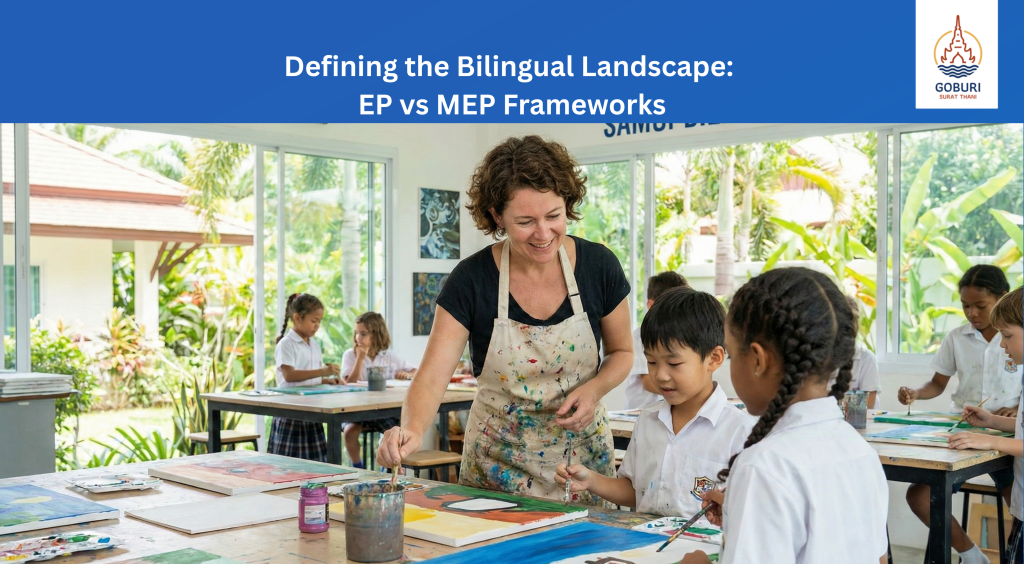
Defining the Bilingual Landscape: EP vs MEP Frameworks
A primary task for parents navigating the Surat Thani education guide is understanding the regulatory terminology used by the Thai Ministry of Education. The terms English Program (EP) and Mini English Program (MEP) describe specific curricular structures with varying levels of immersion and resource allocation.
English Program (EP)
The English Program (EP) is a government initiative offered by both public and private schools. In an EP classroom, English serves as the primary medium of instruction for approximately 50% to 80% of the available subjects.
This model typically focuses on core academic subjects such as Mathematics, Science, and English Language Arts. At the primary level, selected subjects are taught in English by foreign teachers, while the secondary level expands this immersion to all subjects except for Thai Language and Social Studies.
The primary advantage of the EP route is its ability to foster dual language proficiency. This hybrid approach helps students maintain a strong connection to Thai culture while benefiting from the advantages of English medium education.
For families who plan to live in Thailand long term, these programs are often the best option as they offer closer links to Thai society. These programs are designed to prepare students for both Thai and international higher education pathways.
Mini English Program (MEP)
The Mini English Program (MEP) is an alternative initiative operated at a lower cost than the full EP. Under the MEP, the use of English is restricted to between 8 and 14 periods per week.
The use of English is generally limited to not more than 50% of the curriculum at the pre-primary level and specific core subjects at later stages. While subjects like Mathematics and Science are still prioritized for English delivery, the overall immersion level is lower than in a full English Program (EP).
This model serves as an entry point for families who want increased English exposure without committing to the intensive requirements of a full bilingual or international track.
The following table clarifies the typical subject distribution and immersion levels across these programs as governed by the Thai Ministry of Education.
Program Category
English Instruction Frequency
Core Subjects Taught in English
Primary Target Audience
English Program (EP)
50% to 80% of total periods
Math, Science, English, PE, ICT
Long-term expats, bilingual Thai families
Mini English Program (MEP)
30% to 50% of total periods
Math, Science, English
Local families seeking base proficiency
Standard Private Thai
< 20% of total periods
English as a subject only
Traditional Thai learners
Source: Thai Ministry of Education
Financial Architecture of Bilingual Education
When evaluating the cost of expat life in Surat Thani, education is frequently the most significant recurring expense. However, the mainland offers a distinct financial advantage when compared to neighboring islands.
Annual Tuition Fee Expectations
Annual fees for a high quality English Program (EP) in Surat Thani typically range from 60,000 THB to 180,000 THB. These costs are significantly lower than international schools while still providing foreign teachers for core subjects. Families should note that fees are usually billed in semi-annual installments, providing better cash flow management for the household budget.
Education Level
Program Type
Typical Annual Tuition (THB)
Value Proposition
Kindergarten
English Program (EP)
60,000 to 100,000
Early immersion at a sustainable rate
Primary (G1-G6)
English Program (EP)
80,000 to 140,000
Focus on core STEM subjects in English
Secondary (G7-G12)
English Program (EP)
120,000 to 180,000
Preparation for university entry
All Levels
Mini English Program (MEP)
40,000 to 80,000
Budget-conscious English exposure
Table estimates synthesized from regional school data.
One-Time Investment and Entry Costs
Expat families must budget for a substantial initial investment during the first year of enrollment at a bilingual school in Surat Thani. These fees are generally non-refundable and cover the administrative and security aspects of joining a private institution.
The application and assessment fee typically ranges from 1,500 THB to 5,000 THB. This covers the cost of entrance examinations and language proficiency testing. Upon acceptance, a one-time admission fee is required to secure a student’s place, which usually falls between 25,000 THB and 50,000 THB.
This is notably more affordable than in Phuket, where such fees can often exceed 100,000 THB. Additionally, a refundable security deposit of 20,000 THB to 30,000 THB is standard across most reputable private institutions.
Hidden and Recurring Expenses
Beyond base tuition, families must account for several recurring annual expenses that are standard across the private sector. An annual general or campus fee of 20,000 THB to 45,000 THB usually covers campus maintenance, basic accident insurance, and digital learning resources.
The cost of a tropical school wardrobe is another factor to consider. Most schools require formal uniforms, PE kits, and cultural or house shirts for specific events. Parents can expect to spend between 4,000 THB and 8,000 THB per child in the first year alone.
For older students, external examination fees for IGCSE or SAT are billed separately and can range from 5,000 THB to 20,000 THB depending on the number of subjects taken.
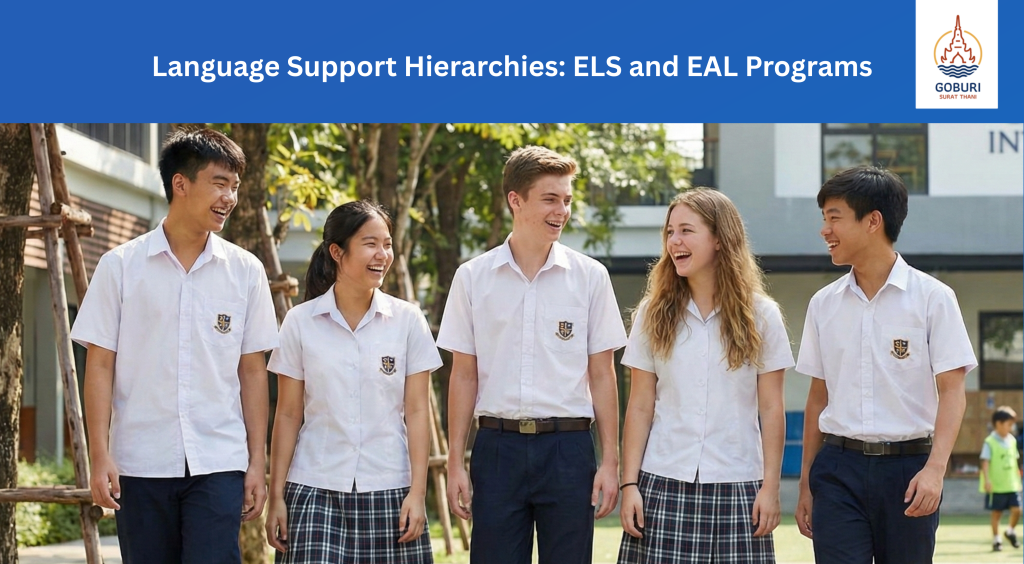
Language Support Hierarchies: ELS and EAL Programs
If a child is not yet fluent in English, most bilingual schools in Surat Thani mandate participation in additional support programs. These English Language Support (ELS) or English as an Additional Language (EAL) services are often divided into proficiency levels and represent an added cost per term.
Support Category
Proficiency Criteria
Typical Fee per Term (THB)
Level 1 Support
Students needing minor confidence or reading help
10,000
Level 2 Support
Students with limited academic English literacy
20,000
Level 3 Support
Students entirely new to the English language
35,000
Data compiled from regional support service structures.
Placement in these programs is usually determined by a head teacher after an initial entrance assessment. While some schools may include basic support in their base tuition, intensive language intervention is almost always billed separately to cover the cost of specialized foreign faculty.
Institutional Landscape: Leading Private Schools with EP Tracks
The market for bilingual schools in Surat Thani is established, providing several options that follow the Thai national curriculum with a heavy English emphasis. These schools are often favored by families who want a balance of Thai discipline and Western academic subjects.
Suratthani Pitayakom School (SPK)
Suratthani Pitayakom is one of the most prominent secondary schools in the region. It features an established English Program that has been recognized for academic excellence. The program employs native English speaking teachers and foreign teachers of various nationalities to teach core subjects like Mathematics, Science, and Social Studies.
The school provides well-equipped facilities including science labs, computer rooms, and specialized foreign language training rooms. SPK also offers Japanese and Chinese language classes to further student multilingualism. For families with children in the secondary bracket, this institution is a key focal point for education in the city.
Thepmitrsuksa School and Thidathip School
Thepmitrsuksa and Thidathip are well-known private institutions in Surat Thani that offer comprehensive English Program tracks. These schools integrate scientific and technological practicing skills into their bilingual curriculum.
For example, Thepmitrsuksa has been noted for its active learning techniques in English listening and speaking courses at the secondary level. Thidathip is another reputable choice that provides a structured environment for younger learners to begin their bilingual journey.
These schools often serve as the primary choice for middle-class Thai families and long-term expats who value the combination of local cultural values and global language skills.
Quality Assurance and the ONESQA Accreditation Process
By law, every private school must undergo ONESQA accreditation assessments at least once every five years. ONESQA ensures that institutions adhere to national quality standards across operations, policy, curriculum, and student well-being. This agency evaluates both the quantitative outcomes and the qualitative processes of teaching and learning within the school.
Additionally, the Office of Private Education Commission (OPEC) conducts internal quality assurance visits every three years. This dual layer of oversight ensures that bilingual schools in Surat Thani maintain high educational standards and meet the expectations of the Thai Ministry of Education.
Language Proficiency Targets (CEFR)
The Ministry of Education has outlined specific Common European Framework of Reference for Languages (CEFR) benchmarks for students in special programs like the EP. These targets help parents track their child’s progress against global standards.
School Stage
Program Type
Target CEFR Proficiency
Primary (G1-G3)
English Program (EP)
A1 to A2 (Elementary)
Primary (G4-G6)
Mini English Program (MEP)
A2 (Waystage)
Secondary (G7-G12)
Mini English Program (MEP)
B1 to B2 (Independent)
Secondary (G10-G12)
English Program (EP)
B2 to C1 (Effective Proficiency)
Data sourced from official CEFR benchmarks.
Pedagogy and Curriculum: Integration of Rote and Active Learning
Parents moving from Western countries often notice a different pedagogical approach in Thai bilingual schools. The traditional Thai system emphasizes rote learning, discipline, and memorization more than the inquiry-based models common in some Western systems.
However, many private bilingual schools in Surat Thani have begun to integrate Western-style teaching philosophies that focus on student-centered learning. This shift towards active learning is particularly visible in EP classrooms where foreign teachers lead the instruction.
Parents should set realistic expectations regarding the level of structure and discipline in the classroom, which is often more formal than in Western schools.
The Expat Family Life Cycle: Strategic Transitions
A common strategy for expat families in Surat Thani is to utilize the strengths of different school systems at different stages of a child’s development.
The Early Years Immersion Advantage
For children between the ages of 3 and 7, many families opt for full immersion in Thai private schools. At this age, children are remarkably adept at picking up the Thai language, often achieving near-native fluency within a few years. This is a major advantage for families planning long-term residency, as it allows children to communicate effectively with the local community and build deep cultural roots.
Transitioning to the English Program (EP)
As children reach secondary school age, the linguistic and cultural gap between the Thai national curriculum and Western academic standards can become more pronounced.
At this stage, most expat families transition their children into a full English Program (EP). This transition ensures that the student maintains competitive academic standards for higher education while still benefiting from their foundational Thai language skills.
The academic rigor of an EP secondary track is essential for students who plan to eventually attend universities in their home countries.
Living in Surat Thani: Logistics and Infrastructure for Families
The practicalities of daily life in Surat Thani are often more manageable for families than in larger, more congested cities.
Housing and the Moo Baan Lifestyle
Most expat families choose to live in Moo Baans, which are gated communities that provide a safe environment for children. These neighborhoods offer a sense of security and a community feel that is often lacking in high-rise living environments. School runs in the city are relatively short, but choosing a home near the major educational corridors can save significant travel time each day.
Transportation and Accessibility
Within the city, transportation is straightforward, and most families find it essential to have their own vehicle for school runs and daily errands. The city is well connected to regional travel routes and features its own airport and main railway station, making travel to other parts of Thailand easy.
Healthcare and Safety
The city provides reliable healthcare infrastructure with multiple hospitals capable of routine and emergency care. For expat families, health insurance is a standard requirement, and many schools include a basic level of accident insurance for students within their annual fees. Surat Thani is generally perceived as a safe and stable environment for raising a family, offering a predictable rhythm of life.
Higher Education Pathways: The TCAS System
Students graduating from bilingual schools in Surat Thani typically enter the Thai University Central Admission System (TCAS) if they plan to stay in Thailand for higher education.
The TCAS system is divided into several admission rounds, including a Portfolio Round, a Quota Round, and a Direct Admission Round. Students from EP backgrounds often have an advantage in the Portfolio Round because their curriculum frequently includes projects and presentations that demonstrate academic talent.
Many top Thai universities offer international programs where the language of instruction is English. These programs accept qualifications from Thai secondary schools (Matthayom 6) and often require proof of English proficiency through tests like IELTS or TOEFL. For students who want to bridge the gap between Thai and international standards, these pathways provide a clear route to professional success.