We occasionally share updates when important information changes or new long-form guides are published. Just practical updates related to long-term living in Surat Thani and Southern Thailand.
The decision to relocate a family to Southern Thailand represents a significant transition from a holiday mindset to a structural understanding of provincial systems. While many expat parents first encounter the region through the lens of short-term travel to the islands of Koh Samui or Koh Phangan, building a permanent base on the Surat Thani mainland requires a clinical evaluation of the available infrastructure.
Education in Surat Thani serves as the primary anchor for these families, offering a level of stability and authenticity that is increasingly rare in the more tourist-centric provinces of Phuket or Bangkok. This report provides an exhaustive analysis of the educational realistic expectations for parents landscape, focusing on the realistic expectations for tuition fees, curriculum standards, and the logistical hurdles of Thailand residency.
The Strategic Advantage of the Surat Thani Mainland
Surat Thani functions as a provincial capital that does not cater to transient tourists. This characteristic makes it a preferred destination for professionals and families seeking long-term stability. The province offers a grounded environment that stands in sharp contrast to the high-pressure energy of the capital or the volatility of the islands.
One of the most significant benefits of the Surat Thani mainland is the mainland discount. Families often find that they can access high-quality instruction and modern facilities without the luxury lifestyle premium found in more saturated markets.
Financial sustainability forms the foundation of any successful relocation plan. While the region is more affordable than Western hubs, it is not a low-cost fantasy for those requiring international standards.
Expat parents must recognize that education in Surat Thani is often the single largest line item in a family budget. However, when compared to the costs in Phuket or Bangkok, the financial advantage is distinct and measurable.
Structural Overview of the Thai Education System
The Thai education system is overseen by the Ministry of Education and is divided into public and private sectors. Education is compulsory for nine years, and the state provides fifteen years of free basic education for Thai nationals.
For expat parents, however, access to the free public system is restricted. Only children with at least one Thai parent who have their birth registered in Thailand are considered Thai nationals and entitled to free education. Foreign children may attend public schools, but they are required to pay tuition fees.
Public education in Thailand is structured into four main levels. These include pre-elementary (ages 3 to 5), elementary (Prathom 1 to 6, ages 6 to 11), lower secondary (Matthayom 1 to 3, ages 12 to 14), and upper secondary (Matthayom 4 to 6, ages 15 to 17).
Most foreign families opt out of the standard public track due to concerns regarding large class sizes, which can reach up to 55 students, and a curriculum heavily dependent on rote memorization. Instead, the majority of expat parents choose between international schools, private bilingual schools, or English Program (EP) tracks within established institutions.
Tiered Schooling Options for Expat Families
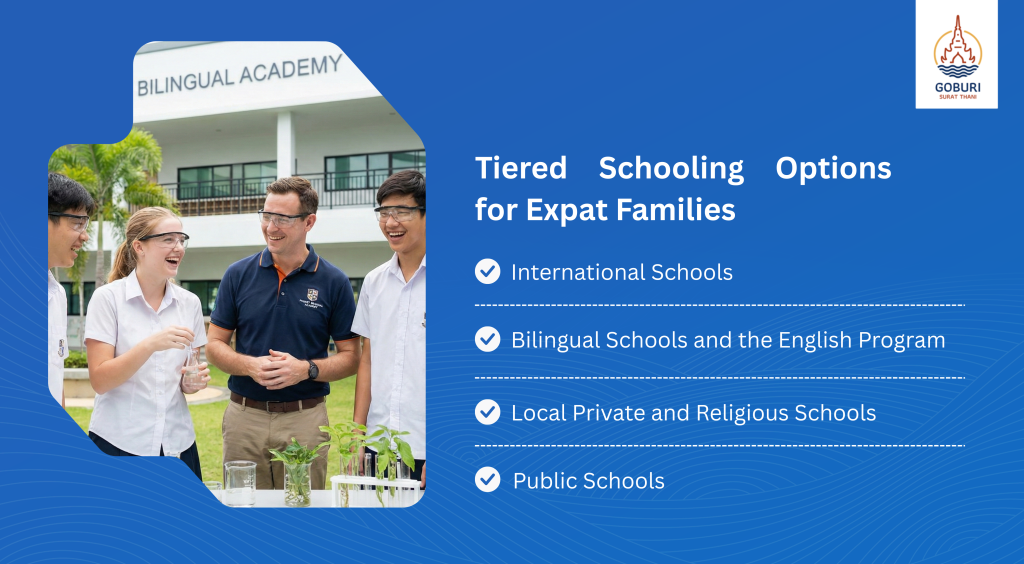
The educational landscape in Surat Thani is tiered to accommodate different budgets and long-term goals. Understanding the differences in curriculum and immersion is essential for selecting the right institution.
International Schools
International schools in Surat Thani are characterized by their adherence to globally recognized standards such as the British National Curriculum, the American Common Core, or the International Baccalaureate (IB). These institutions are designed to provide a seamless transition for students who may eventually move to different countries or gain access to broad options for higher education.
Institutions like Daniel International School (DIS) and Suratthani International School (STIS) focus on holistic development. Their philosophies often go deeper than basic knowledge, emphasizing critical thinking, creativity, and discernment.
DIS, for instance, operates with a mission to develop students who impact the world with intelligence, integrity, and love. These schools offer smaller class sizes, typically limited to 20 or 25 students, allowing for personalized support and stronger teacher-student relationships.
Bilingual Schools and the English Program
Bilingual schools offer a middle ground for families seeking a balance between Thai culture and English-medium instruction. These schools often follow the Thai National Curriculum but deliver core subjects in English. The English Program (EP) is a specific government initiative where subjects are taught by teachers hired from abroad.
For families planning to live in Thailand long-term, bilingual schools provide an opportunity for children to develop closer links to the local society while still accessing a higher standard of education than traditional public schools.
The degree of English proficiency in these schools can vary, and expat parents are advised to evaluate individual programs carefully before enrollment.
Local Private and Religious Schools
Surat Thani also hosts a variety of local private schools, many of which have religious affiliations, such as Christian or Catholic foundations. These schools often provide better facilities and more extracurricular activities than public government schools.
While the primary language of instruction is Thai, they may offer supplementary English classes. These institutions are well-suited for families that prioritize a firm foundation in Thai language, culture, and history.
School Tier
Primary Curriculum
Typical Language of Instruction
Main Advantage
International Schools
British, American, or IB
English
Global mobility and higher education access
Bilingual Schools
Thai National with EP
Thai & English
Cultural integration and cost-effectiveness
Local Private Schools
Thai National
Thai
Strong local cultural foundation
Public Schools
Thai National
Thai
High immersion for Thai nationals
Financial Realities: Detailed Cost Analysis
The cost of education in Surat Thani is significantly lower than in tourist-heavy regions. For the 2025-2026 academic year, tuition fees on the mainland are optimized for families who do not require the luxury lifestyle premium.
Annual Tuition Fee Structures
Tuition fees generally increase as a student progresses through the grade levels. Early years and kindergarten fees are the most affordable, while secondary years see a rise in costs due to specialized facilities and examination requirements.
Grade Level
Annual Tuition (Mainland)
Koh Samui (Island)
Phuket (Island)
Kindergarten (Early Years)
180,000 – 235,000 THB
220,000 – 350,000 THB
250,000 – 450,000 THB
Primary (Years 1 to 6)
250,000 – 310,000 THB
340,000 – 480,000 THB
380,000 – 715,000 THB
Secondary (Years 7 to 11)
280,000 – 350,000 THB
390,000 – 575,000 THB
460,000 – 930,000 THB
One-Time Enrollment and Assessment Fees
Parents must prepare for initial costs upon admission. These one-time payments secure a student’s place and cover administrative overheads. In Surat Thani, these fees are significantly more accessible than in neighboring provinces.
Application Fee: Typically ranges from 1,500 THB to 5,000 THB per student.
Admission/Enrollment Fee: A one-time, non-refundable payment ranging from 25,000 THB to 50,000 THB.
Refundable Security Deposit: Generally required to be between 20,000 THB and 30,000 THB, which is returned upon withdrawal given proper notice.
Recurring and Supplementary Expenses
Beyond basic tuition, families should budget for additional annual and incidental costs. These can add a substantial amount to the yearly expenditure.
General Learning Material Fee: 25,000 THB to 40,000 THB for books, ICT, and insurance.
English Language Support (ELS): Mandatory for students needing extra English instruction, costing between 10,000 THB and 35,000 THB per term.
Uniforms and Stationery: Approximately 5,000 THB to 8,000 THB per year.
External Exams: IGCSE or SAT exam fees can range from 5,000 THB to 20,000 THB.
Legal Framework: Visas and Residency for Families
The legal right to reside in Thailand is a critical pillar of stability. For families with children in the education system, the primary route involves the student visa and the guardian visa.
The Non-Immigrant ED Visa (Student Visa)
A child enrolled in a formal school is eligible for a Non-Immigrant ED visa. The school typically provides the necessary documentation to apply for an initial 90-day visa at a Thai embassy or consulate outside the country.
Once in Thailand, the visa is extended for one year at the local immigration office. Parents are advised that children may need to leave the country for a weekend to a nearby nation like Malaysia or Laos to activate this visa type if they initially entered on a tourist exemption.
The Non-Immigrant O Visa (Guardian Visa)
One parent or legal guardian per student is entitled to a one-year guardian visa. This visa is an ideal solution for long-term stays during a child’s education. The most critical requirement for this visa is the financial threshold.
The applicant must show proof of at least 500,000 THB in a Thai bank account. This money must remain in the account for two months before the initial application and three months before each annual renewal.
It is important to note that only one parent can be the official guardian on this specific visa type. If the family has two children, each parent can potentially obtain a guardian visa by being linked to a different child.
For families with one child, the second parent must find an alternative path, such as the Destination Thailand Visa (DTV) for remote workers or a Retirement Visa if they meet the age and financial requirements.
Cultural Integration and Classroom Dynamics
Adapting to education in Surat Thani involves more than just selecting a school. It requires a mental transition to a classroom culture that prioritizes respect, hierarchy, and harmony.
The Teacher-Student Relationship
In Thai culture, teachers are afforded a high degree of respect. This creates a positive environment where behavioral management is often less difficult than in many Western countries.
Students show respect through gestures such as the Wai, a prayer-like greeting with palms pressed together. Children are expected to stand when a teacher enters the room and use polite particles like “kha” or “khrab” in their speech.
The Importance of “Saving Face”
Thai society is characterized by the principle of saving face. This means that public disputes, harsh criticism, or emotional outbursts are strictly avoided to preserve mutual dignity. In the educational context, this implies that feedback from teachers may be indirect.
Expat parents should approach meetings with administrators with patience and a focus on maintaining harmony, as aggressive behavior is seen as a loss of emotional control and can be counterproductive.
Modesty and Dress Codes
Cleanliness and neatness are essential components of professionalism in Thai schools. Both students and teachers are expected to dress modestly. For parents visiting the campus, this generally means covering the shoulders and knees.
Tattoos and piercings are often frowned upon in more conservative provincial schools. Removing shoes before entering classrooms or homes is a standard practice that reflects respect for the cleanliness of the indoor environment.
Socio-Psychological Challenges for Third Culture Kids
Relocating to a new country can be both exhilarating and unsettling for children, particularly teenagers who are leaving behind established social networks. These children, often referred to as Third Culture Kids (TCKs), may struggle with culture shock or a feeling of disorientation.
Emotional and Academic Adjustments
Teens may feel the pressure to fit in quickly but may lack the language skills or cultural context to do so. Recognizing symptoms of stress, such as withdrawal or irritability, is vital for parents. Providing emotional support at home through shared rituals and open conversations can help anchor a child during this transition.
Additionally, adjusting to a new educational system, whether it involves project-based learning or a heavy focus on teamwork, can add layers of academic pressure.
The Impact of Teacher Turnover
International schools often face challenges with faculty retention. Expatriate teachers may leave at the end of their first contract due to administrative issues or personal circumstances. High turnover can negatively impact the quality of teaching and the ability of students to form stable, trust-based relationships.
Parents should look for schools that prioritize teacher well-being and consistent leadership, as these factors contribute significantly to a child’s sense of belonging and academic success.
Extracurricular and Community Life in Surat Thani
Outside of formal schooling, Surat Thani offers a variety of activities that help families integrate and find a sense of community. The city’s geography provides unique opportunities for adventure and relaxation.
Recreational Hubs: Ko Lamphu Park
Ko Lamphu Park is the largest green space in Surat Thani and serves as a central oasis for families. Located on an island in the Tapi River, it offers winding walking and biking paths, football fields, and basketball courts. It is a prime location for observing local life and enjoying sunsets over the river.
The park is well-maintained and provides a peaceful environment for jogging or strolling amidst lush greenery.
Modern Conveniences at Central Plaza
For indoor activities, Central Plaza Surat Thani is the primary hub. It hosts Fun Planet, an indoor entertainment center suitable for all ages with games, simulation machines, and play areas for children. The mall also provides a variety of family-friendly dining options and shopping facilities, making it a staple of expat life in the city.
Nature and Regional Exploration
The province is a gateway to some of Thailand’s most spectacular national parks. Khao Sok National Park, famous for its jungle trekking and stunning scenery, is a short drive from the city center.
Families can engage in bamboo rafting, birdwatching, and visits to elephant sanctuaries that prioritize conservation. These experiences provide a unique education in biodiversity and local history that cannot be replicated in a classroom.
Long-term Sustainability and Decision-making Filters
For expat parents, the move to Surat Thani is often a strategic choice based on value and authenticity. To ensure long-term success, families must evaluate their options through several critical filters.
Neighborhood Proximity and Commutes
Most long-term residents live in gated communities known as Moo Baans. Suburbs like Khun Thale and Makham Tia have become primary hubs for expat families due to their proximity to major international schools. Choosing a home near the school can significantly reduce daily commute times and improve the overall quality of life.
Curriculum Alignment with Future Goals
Parents must decide whether a British or American curriculum best suits their child’s future academic ambitions. International schools often provide standardized evaluations such as IGCSE or A-Levels, which are crucial for university admission worldwide.
If the family intends to stay in Thailand permanently, a bilingual schools track may be more beneficial for developing high-level Thai language proficiency.
Community Integration and Support Systems
Building a support system is essential for overcoming the challenges of expat life. Many schools have parent-led LINE or WhatsApp groups that offer a space to ask questions and build rapport with other families.
Engaging with both locals and other expats through school events, sports clubs, or volunteer opportunities can make the experience more rewarding and sustainable.
Decision Factor
Low Integration / High Mobility
High Integration / Long-Term Residency
School Choice
High-tier International School
Bilingual or EP School
Curriculum
IB or British National
Thai National with English Focus
Residency
Guardian Visa + DTV
Long-Term Resident (LTR) Visa
Language Goal
English Fluency
Full Bilingualism
The Role of Accreditation in School Selection
When choosing a school, accreditation serves as a fundamental indicator of institutional integrity and academic excellence. In Thailand, all international schools are required by law to secure accreditation from a recognized overseas agency by the end of their fifth year.
Recognized Accreditation Bodies
Parents should look for certifications from global organizations that validate a school’s commitment to international benchmarks. These include the Council of International Schools (CIS), the Western Association of Schools and Colleges (WASC), and the Council of British International Schools (COBIS).
Additionally, schools must undergo assessment by the Office for National Education Standards and Quality Assessment (ONESQA), which ensures adherence to Thai national quality standards.
Quality Assurance Mechanisms
Accredited schools are typically granted certification for a designated period, necessitating regular re-accreditation. This process involves a thorough review of teaching practices, student well-being, and operational policies.
For expat parents, these accreditations provide an objective measure of quality, ensuring that the education provided meets the standards required for entry into universities globally.
Practical Tips for Relocating Families
A successful transition to education in Surat Thani requires meticulous planning and a proactive approach to logistical challenges.
Documentation and Legalization
Families must ensure that all academic and personal documents are properly legalized. This includes original bachelor’s degree certificates for teaching staff or marriage and birth certificates for guardian visa applicants. Many Thai agencies and schools require notarized copies of these documents during the application process.
Financial Planning and Emergency Funds
Maintaining an emergency fund is highly recommended for expat families. A contingency of at least 200,000 THB can cover unexpected medical expenses, vehicle repairs, or emergency travel.
Furthermore, tuition fees are typically billed in advance, and late payments can incur penalties. Paying a full year upfront often yields a discount of approximately 5%.
Managing the “Honeymoon Phase”
The initial excitement of moving to Thailand is often followed by a period of adjustment as the reality of daily life sets in. Navigating the language barrier and cultural frictions requires patience. Families who choose to integrate into local systems and embrace the pace of life in a provincial city are more likely to thrive in the long term.
Realistic Expectations for the Future
Education in Surat Thani in 2026 and beyond offers a compelling alternative to the traditional expat hubs of Thailand. For expat parents, the province provides a unique combination of modern infrastructure, affordable tuition fees, and a stable, family-oriented environment.
While the region requires a willingness to adapt to a more conservative and locally focused culture, the benefits of the Surat Thani mainland are substantial.
By understanding the tiered educational options, preparing for the financial commitments, and navigating the legalities of the student visa and guardian visa, families can build a successful and sustainable life in Southern Thailand.
Surat Thani does not offer a fantasy version of the country. Instead, it provides a functional and authentic foundation where children can grow into well-rounded, global citizens while remaining deeply connected to the rich traditions of their host nation. Success here is defined by a commitment to professional-grade planning and a genuine desire to integrate into the city of good people.