We occasionally share updates when important information changes or new long-form guides are published. Just practical updates related to long-term living in Surat Thani and Southern Thailand.
The global perception of Thailand as an effortless retirement destination is increasingly coming into conflict with a modernized and highly regulated administrative reality. For many years, the Thailand Retirement Visa was viewed as a simple formality for those aged 50 and over.
However, the Thai government has transitioned toward a system that prioritizes financial transparency, digital compliance, and high-value residency. This evolution is most visible in the tension between the traditional Non-Immigrant O pathways and the newer, more robust frameworks like the Long-Term Resident Visa or LTR.
The core of the current residency environment is defined by a move away from “visa runs” and informal stay extensions toward a rigorous compliance-based model. This shift has significant implications for how retirees manage their wealth, their health coverage, and their daily administrative obligations.
Understanding the retirement visas vs reality involves recognizing the difference between the marketing of a tropical lifestyle and the granular legal requirements of the Immigration Bureau. This is the first step toward a successful long-term stay in the Kingdom.
The Financial Pillars of Residency: The 800,000 THB Deposit and Beyond
The most critical element of any Thailand Retirement Visa application is the demonstration of financial self-sufficiency. The Thai authorities use specific benchmarks to ensure that foreign residents do not become a burden on the state.
The most common requirement remains the 800,000 THB deposit held in a Thai Bank Account. This amount, which is approximately $22,000 USD depending on exchange rates, must be seasoned according to strict timelines.
For the initial extension of a Non-Immigrant O visa, the funds must be in the account for at least two months before the application date. Following the approval of the extension, the money must remain in the account for an additional three months.
For every subsequent year, the requirement increases: the 800,000 THB must be present for three months before the renewal and three months after.
Furthermore, the balance is not permitted to drop below 400,000 THB at any point during the remainder of the year.
Financial Option
Minimum Requirement
Verification Method
Security Deposit
800,000 THB in Thai Bank
Updated Bank Book and Bank Guarantee Letter
Monthly Income
65,000 THB per month
12-month Bank Statements or Embassy Affidavit
Combination
Total of 800,000 THB annually
Mix of deposit and documented income
The mechanism for proving income has also become more stringent. While some embassies previously issued income affidavits based on self-reporting, most major Western nations have shifted the burden to the individual.
Retirees must now show a consistent inflow of at least 65,000 THB into a Thai account from an overseas source for 12 consecutive months. This data is verified through the Thai bank’s internal coding, which identifies international transfers.
Understanding the Retirement Visas vs Reality of the Non-Immigrant O-A
A significant source of confusion for new arrivals is the distinction between the Non-Immigrant O and the Non-Immigrant O-A visas. While both are intended for retirement, they carry vastly different long-term obligations, particularly regarding Health Insurance Thailand mandates.
The Non-Immigrant O-A is typically applied for at an embassy or consulate in the applicant’s home country. It provides a one-year stay upon entry but requires a comprehensive criminal record check and a medical certificate from the home country.
Its most defining characteristic is the mandatory requirement for Thai health insurance that meets the minimum coverage of 400,000 THB for inpatient care and 40,000 THB for outpatient care. In 2026, many O-A holders find that the insurance requirement is the most significant recurring cost of their residency.
The Non-Immigrant O, by contrast, is often obtained as a 90-day visa that is then converted into a one-year retirement extension within Thailand. Historically, this in-country extension did not always require the same level of health insurance as the O-A.
However, local immigration offices have been granted increasing discretion, and many provinces now require proof of coverage or a significant bank balance to offset potential medical costs. This “in-country” route is often preferred by those who find it difficult to secure compliant insurance from Thai providers due to age or pre-existing conditions.
The Long-Term Resident LTR Visa: The Modern Alternative
For those with substantial assets, the Long-Term Resident Visa or LTR represents the pinnacle of Thai residency options. Introduced to attract “high-potential” foreigners, the LTR Wealthy Pensioner category offers a ten-year renewable framework that bypasses much of the annual friction associated with standard retirement visas.
The LTR is not merely a lengthier stay permit: it is a strategic tool for wealth preservation.
The eligibility for the LTR Wealthy Pensioner category is rigorous. Applicants must be at least 50 years old and demonstrate an annual passive income of at least $80,000 USD. If the annual income falls between $40,000 and $80,000 USD, the applicant must also hold an investment of at least $250,000 USD in Thai government bonds, foreign direct investment, or Thai property. This high financial bar is balanced by unparalleled benefits, including a fast-track service at international airports and a reduction in reporting requirements.
Feature
Thailand Retirement Visa (O/O-A)
LTR Wealthy Pensioner
Validity
1 Year (Renewable)
10 Years (5+5 Years)
Reporting
Every 90 Days
Once per Year
Airport Perks
Standard
Fast-track Immigration
Work Rights
Prohibited
Digital Work Permit Possible
Tax on Foreign Income
Remittance-based (subject to change)
0% Exemption
The LTR also allows for the inclusion of a spouse and up to four children under the age of 20. This makes it a far more cohesive option for families than the standard retirement visa, where each spouse must often qualify independently or apply for a separate “O” dependent visa which carries its own set of restrictions.
The Evolution of Thai Tax Laws: 2024 to 2026 Overview
The most profound shift in the Thai Immigration Reality is the fundamental change in the taxation of foreign income. For decades, Thailand was a de facto tax haven for many retirees.
Foreign income was only taxable if it was remitted into the country in the same calendar year it was earned. By delaying transfers by one year, retirees could legally avoid Thai income tax entirely. This era ended on January 1, 2024, with the introduction of Revenue Department Instruction Por. 161/2566.
Under the new rules, any foreign-sourced income brought into Thailand by a tax resident is taxable, regardless of when it was earned. A tax resident is defined as any person who spends 180 days or more in Thailand within a single calendar year. This means that pensions, dividends, and interest earned abroad are now potentially subject to progressive Thai tax rates of up to 35% if they are used to fund a life in the Kingdom.
However, the 2025 and 2026 landscape has seen the introduction of transition guardrails and proposed relief. Instruction Por. 162/2566 clarified that income earned before January 1, 2024, is still subject to the old rules and is generally exempt from tax even if remitted later.
Furthermore, a draft proposal in mid-2025 suggested a two-year window where income earned in 2024 or later could be remitted tax-free if it occurs within the year earned or the subsequent year. This proposal is intended to mitigate the sudden compliance burden on the expat community while signaling a move toward more globalized tax standards.
For high-income retirees, the LTR visa offers a critical “tax shield.” LTR holders in the Wealthy Global Citizen and Wealthy Pensioner categories are explicitly exempt from tax on foreign-sourced income, regardless of when it is remitted. This benefit alone makes the LTR mathematically superior to the Thailand Privilege Visa for those who meet the income thresholds and plan to live in Thailand for the majority of the year.
Health Insurance Thailand: Navigating the Coverage Cliff
As retirees age, the requirement for Health Insurance Thailand becomes both more essential and more difficult to satisfy. The Thai government is increasingly concerned about the burden that uninsured foreigners place on the public hospital system. This has led to a tightening of insurance mandates and a move toward higher coverage minimums.
For the Non-Immigrant O-A Visa, the policy must be from a provider approved by the Thai General Insurance Association (TGIA).
The actuarial reality for those over 70 is stark. Many local insurers stop accepting new applicants after the age of 75, and those that do often exclude pre-existing conditions like heart disease, diabetes, or cancer.
For a healthy 70-year-old, a basic compliant policy can cost between 70,000 and 100,000 THB per year. If one opts for international comprehensive coverage, premiums can skyrocket to $5,000 or $10,000 USD annually.
Age
Basic Local Premium (Est. THB)
Comprehensive International (Est. USD)
50
20,000 – 35,000
$1,500 – $2,500
60
40,000 – 60,000
$2,500 – $4,500
70
70,000 – 120,000
$5,000 – $8,000
80
Renewal Only / Limited
$10,000+
The LTR visa provides a unique alternative for those who cannot or do not wish to purchase private insurance. Applicants can waive the $50,000 USD insurance requirement by maintaining a secured deposit of at least $100,000 USD in a Thai bank account. This “self-insurance” model is a recognition of the difficulties faced by older retirees in the private insurance market.
The Administrative Rhythm: 90-Day Reporting and TM30
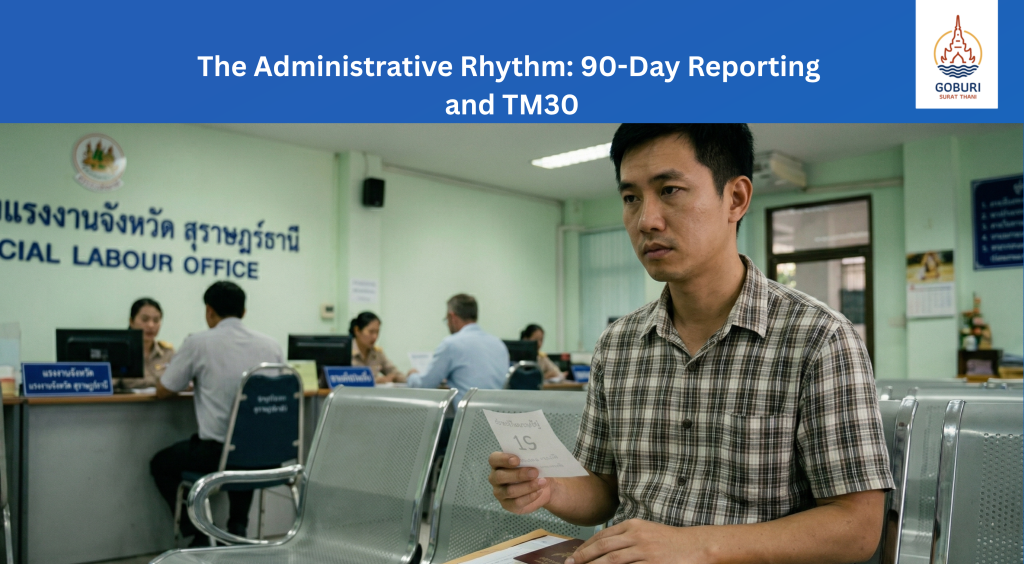
Living in Thailand on a retirement visa requires a commitment to administrative punctuality. The most famous of these requirements is the 90-day reporting, where every long-term resident must notify the Immigration Bureau of their current address every three months.
While this can be done online or by mail, the digital portal frequently experiences downtime, forcing many retirees to visit the immigration office in person.
Equally important is the TM30 form, which is a notification of residence that must be filed by the landlord within 24 hours of a foreigner’s arrival at a property. Although the legal burden is on the landlord, the consequences for non-compliance often fall on the retiree.
Immigration offices typically require a recent TM30 receipt for almost every transaction, from visa extensions to obtaining a residency certificate for a driver’s license. For those who travel frequently within Thailand, the need to file a new TM30 after every hotel stay can become a significant logistical burden.
Failure to adhere to these reporting rules can result in fines and, more importantly, can create a “black mark” on one’s immigration record. In an era where the Thai authorities are increasingly using biometric data and integrated databases, maintaining a flawless compliance record is essential for the smooth renewal of any long-term visa.
Banking Hurdles and the Anti-Money Laundering Crackdown
One of the most surprising challenges for new retirees is the difficulty of opening a Thai Bank Account. In 2025 and 2026, the Bank of Thailand has implemented a major crackdown on “mule accounts” used for fraud and money laundering. This has led many banks to refuse service to anyone on a tourist visa or a short-term entry permit.
The paradox is that many retirees need the bank account to deposit the 800,000 THB required for the visa, but they cannot get the account without the visa.
To break this loop, the recommended path is to first secure a 90-day Non-Immigrant O visa from an embassy abroad. This visa serves as the “anchor” that banks require to perform their due diligence.
Even with a long-term visa, retirees should expect a rigorous onboarding process that includes biometric physical face scans and passport chip-reads. Some branches in the Central Business Districts of Bangkok or major expat hubs like Pattaya are more accustomed to foreign clients, but the days of “walking in and opening an account in ten minutes” are largely over.
Contingency Planning: Spousal Death and Inheritance
A realistic retirement plan must account for the legal complexities of death and succession in a foreign country. For married couples, the visa status of the surviving spouse is a primary concern.
If a foreigner is staying in Thailand on an “O” visa based on marriage to a Thai national, that visa loses its legal basis the moment the Thai spouse passes away. While immigration officers are generally compassionate and allow a period of transition, the survivor must quickly convert to a retirement-based extension if they meet the age and financial criteria.
Inheritance is another area where retirement visas vs reality often clash with expectation. Under the Land Code Section 93, a foreigner who inherits land from a Thai spouse is legally permitted to receive the property but is not allowed to keep it.
The law requires the foreign heir to sell or dispose of the land within one year of the transfer. If the property is not sold within this window, the Land Department has the power to seize and auction the land. This underscores the importance of structured succession planning, such as the use of usufructs or long-term leases, to protect the surviving spouse’s right to live in the family home.
Furthermore, a Thai will is an absolute necessity for anyone with a 800,000 THB deposit in a local bank. Without a local will, the probate process can take up to a year, during which time the funds are frozen. This can leave the surviving spouse unable to prove the financial requirements for their own visa renewal, leading to a cascade of legal and residency problems.
Strategic Insights: Why Visas Should Not Drive Location Choice
A common mistake among prospective retirees is allowing the ease of a particular visa to dictate where they choose to live. This is often seen in the context of the Thailand Privilege Visa, which is essentially a paid membership that provides a long-term visa as a perk.
While the Privilege program is convenient and bypasses the financial seasoning and annual renewal hurdles, it offers no tax benefits and can be significantly more expensive than the traditional retirement routes over a twenty-year horizon.
The choice of location within Thailand should be driven by lifestyle needs, healthcare access, and the local cost of living, rather than purely by administrative convenience.
For example, Bangkok offers the highest level of specialist medical care but comes with higher rents and pollution. Chiang Mai provides a cooler climate and a lower cost of living but faces a severe “smoke season” in the early months of the year. Coastal areas like Phuket or Koh Samui offer an island lifestyle but are subject to higher prices and seasonal monsoon risks.
City
Cost Level
Healthcare Access
Best For
Watch-outs
Bangkok
High
Top-tier
Urban amenities
Traffic, Pollution
Chiang Mai
Low – Mid
Good
Value, Community
Burning Season
Hua Hin
Mid
Good
Beach, Sleepy feel
Quieter Nightlife
Phuket
High
Very Good
Island living
Tourist pricing
Pattaya
Low – Mid
Good
Budget coastal
Party reputation
Retirees must also consider that different immigration offices in Thailand often have varying interpretations of the national regulations.
An extension that is straightforward in a smaller town might be subject to more scrutiny in the capital. Engaging with the local expat community to understand the provincial immigration office is a vital part of the due diligence process.
The Reality of Work and Volunteering
One of the most strictly enforced rules of the Thailand Retirement Visa is the absolute prohibition on work. This includes not only traditional employment but also remote work for overseas companies and even unpaid volunteer work for a charity.
The Thai authorities define “work” very broadly as “engaging in effort by exerting energy or knowledge whether or not in consideration of wages or other benefits”.
For retirees who wish to remain active, this can be a significant psychological hurdle. Engaging in a hobby that produces income or volunteering at a local animal shelter without a work permit is a violation of the terms of the visa.
Being caught working on a retirement visa can lead to fines, deportation, and a permanent ban on re-entering the country. For those who are not yet ready to fully stop working, the LTR visa or the newer Destination Thailand Visa (DTV) may offer a more suitable legal pathway that allows for remote professional activity.
Mastering the Long-Term Stay
Retiring in Thailand is a multi-layered journey that requires a balance of financial preparation, administrative patience, and legal foresight. The retirement visas vs reality in 2026 is that residency is a privilege that must be actively maintained through strict adherence to the rules of the Kingdom.
From the 800,000 THB deposit seasoning to the evolving landscape of Thai Tax Laws, the successful retiree is one who treats their residency as a serious administrative commitment.
By understanding the nuances of the Non-Immigrant O vs. O-A, the strategic benefits of the LTR, and the necessity of robust Health Insurance Thailand coverage, retirees can build a secure foundation for their golden years.
Thailand remains one of the most rewarding places in the world to live, offering a richness of culture and a quality of life that is difficult to match elsewhere. However, the key to enjoying that life is ensuring that your legal and financial house is in order long before you arrive on the sun-drenched shores of the Land of Smiles.