We occasionally share updates when important information changes or new long-form guides are published. Just practical updates related to long-term living in Surat Thani and Southern Thailand.
For many foreign families, the decision to settle in Southern Thailand often begins with a search for a more sustainable pace of life. While hubs like Phuket and Koh Samui dominate the tourism headlines, Surat Thani has quietly emerged as a primary alternative for those prioritizing stability over spectacle. To understand the broader financial landscape of the region, it is helpful to first review the general cost of living in Surat Thani before diving into the specific needs of a household. Identifying the cost of living in Surat Thani for families is the first step in determining if this mainland anchor provides the right balance of infrastructure and affordability for your long-term plans.
Moving a family involves more than just comparing the price of a local meal or a single-bedroom apartment. It requires a granular look at the 2026 budget reality, where global inflationary trends have begun to influence local Thai markets. Unlike the highly volatile, tourism-dependent economies of the nearby islands, Surat Thani’s costs are grounded in the domestic Thai economy. This provides a level of predictability that is essential for families managing long-term savings or remote-work incomes.
This guide is designed for parents and long-term expats who are researching the practicalities of relocation. We will move past the “paradise” clichés to examine the actual numbers behind housing, education, and daily friction. By the end of this analysis, you will have a realistic framework for what it takes to maintain a comfortable, high-quality family life on the mainland in 2026.
Monthly Housing and Rental Market Realities
Securing the right home is often the most significant factor in stabilizing a family budget. Unlike the hyper-competitive vacation rental markets of the islands, housing on the mainland is primarily built for long-term residency. This shifts the power back to the tenant, allowing for more predictable lease terms and a focus on community-oriented living rather than short-term convenience.
Current Rates for 3 Bedroom Homes in Gated Communities
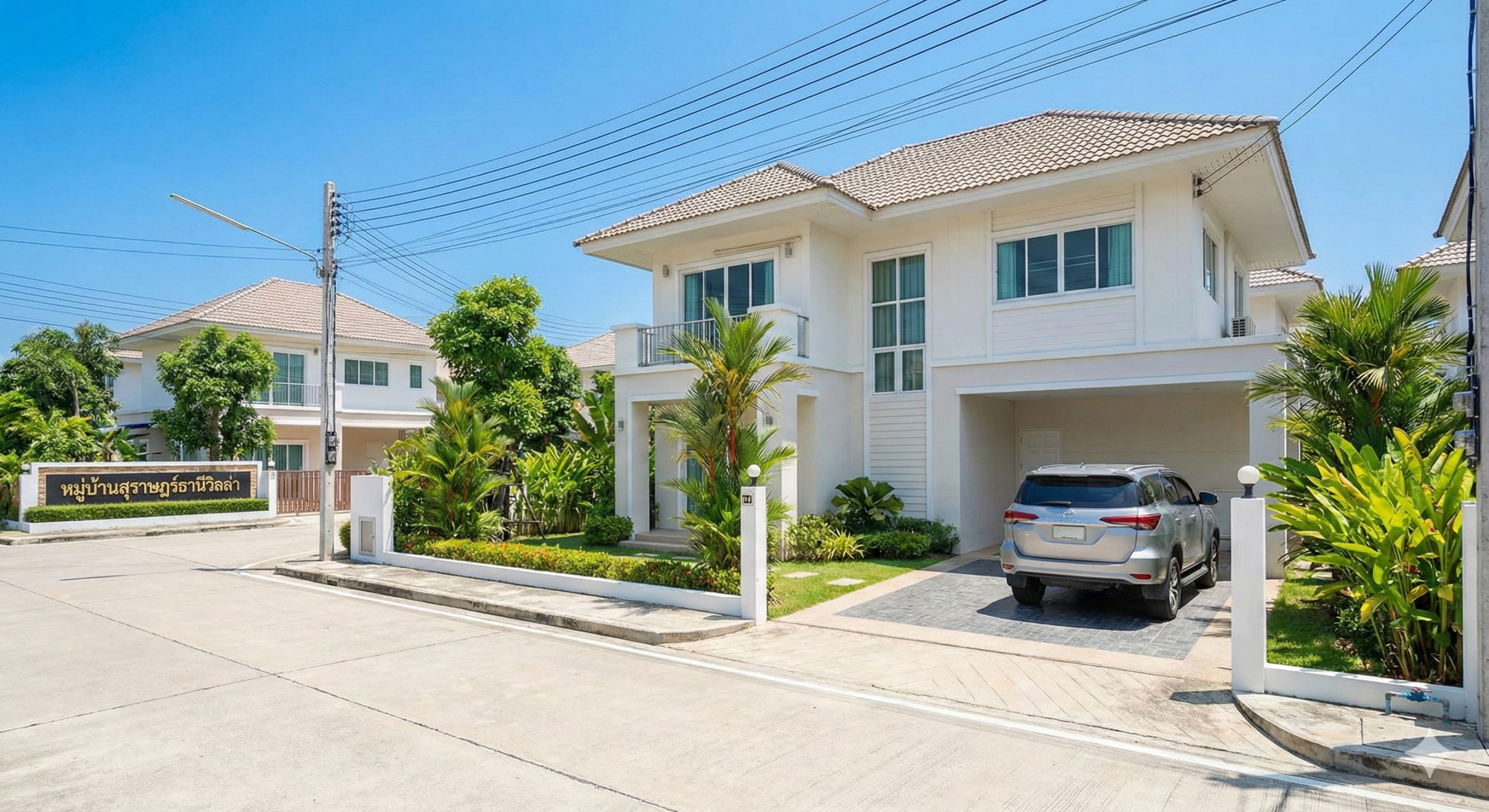
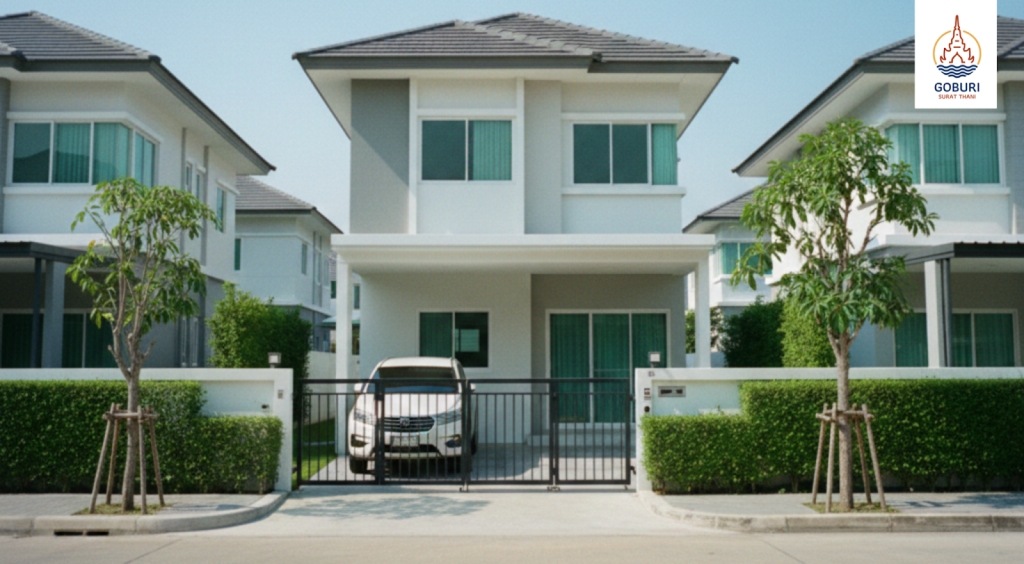
For the 2026 budget reality, the “Muban” or gated community remains the gold standard for foreign families. These estates offer the security and communal space necessary for children, often including a shared park, playground, and 24-hour security personnel.
Standard Family Home: A typical 3-bedroom, 2-bathroom detached house in a well-maintained estate currently ranges between 18,000 THB and 25,000 THB per month. These homes are usually partially furnished and include a small perimeter garden and private parking for two vehicles. You can research active listings on reputable Thai property portals to compare specific estate facilities.
Premium Modern Estates: Newer developments, particularly those featuring contemporary loft designs or clubhouse amenities such as a gym and shared pool, command higher rates. Expect to pay between 28,000 THB and 38,000 THB per month for these properties.
Differences Between Suburban Areas and the City Center
In Surat Thani, your choice of neighborhood is less about nightlife proximity and more about managing the daily school run and grocery logistics.
The Suburbs (Khun Thale and Makham Tia): These areas have become the primary hubs for expat families. The cost of living in Surat Thani for families is often optimized here because rents are lower and you are closer to the main international schools. For instance, families prioritizing proximity to Daniel International School often find larger plots of land and quieter streets for approximately 15% to 20% less than city center equivalents.
The City Center (Near the Tapee River and Central Plaza): Living closer to the urban core offers immediate access to private healthcare, such as Bangkok Hospital Surat, and major shopping malls. However, the inventory primarily consists of older townhouses or high-rise condos. A 3-bedroom unit in the city is rare and often priced at a premium, ranging from 25,000 THB to 40,000 THB, due to the limited supply of large-scale urban family housing.
Utility Deposits and Common Area Maintenance Fees
When finalizing a lease, families must account for contractual costs that are standard across mainland Thailand.
Security Deposits: The standard requirement is two months of rent as a deposit plus the first month of rent in advance. This remains the standard in 2026.
Common Area Maintenance (CAM) Fees: In a gated community, the CAM fee covers security, street lighting, and garbage collection. In most long-term rental agreements, the landlord covers this fee. However, always verify this in your contract. If passed to the tenant, it can range from 500 THB to 1,500 THB per month.
Utility Deposits: If you are the first tenant in a new property, you may be asked to pay a small refundable deposit to the provincial electricity or water authority to activate the meters, typically totaling around 2,000 THB to 5,000 THB.
Education and International School Fees
For families relocating to the mainland, education is often the single largest line item in the cost of living in Surat Thani for families. However, compared to the saturated markets of Bangkok or Phuket, the 2026 budget reality in Surat Thani offers a distinct financial advantage. You are generally paying for quality instruction and facilities without the heavy “luxury lifestyle” premium found in more tourist-centric provinces.
International School Tiers and Tuition Costs
Surat Thani city and the surrounding mainland area host several established international schools, primarily offering British or American curricula. For the 2025–2026 academic year, parents should budget within the following ranges for annual tuition:
Early Years and Kindergarten: Fees typically range from 180,000 THB to 235,000 THB per year. These programs focus on foundational English literacy and social development.
Primary Years (Years 1 to 6): Expect to pay between 250,000 THB and 300,000 THB per year. At this level, schools such as Suratthani International School (STIS) and Balance International School (BISS) introduce more specialized ICT and science facilities.
Secondary Years (Years 7 to 11): Costs increase as students approach IGCSE examinations, with annual tuition ranging from 280,000 THB to 350,000 THB.
Mandatory One-Time Fees and Deposits
When entering the mainland education system, the initial “buy-in” can be significant. It is vital to separate these one-time costs from your recurring monthly outgoings.
Application and Assessment Fees: Most schools charge a non-refundable fee of 1,500 THB to 5,000 THB to process the application and conduct placement testing.
Admission and Enrollment Fees: This is a one-time, non-refundable payment required to secure a seat. In Surat Thani, this typically ranges from 25,000 THB to 50,000 THB. This is notably lower than Phuket, where enrollment fees often exceed 100,000 THB.
Refundable Security Deposits: A deposit of approximately 20,000 THB to 30,000 THB is standard. This is refundable when the child leaves the school, provided the required notice is given.
Seasonal and Additional Expenses
Beyond tuition, several smaller costs contribute to the total annual expenditure. While these may seem minor, they are non-negotiable parts of the school experience.
General Fees: Many schools in the region charge an annual “General Fee” or “Learning Material Fee” of 25,000 THB to 40,000 THB to cover books, ICT subscriptions, and campus insurance.
Uniforms and Stationery: Budget approximately 5,000 THB to 8,000 THB per year for basic school kits.
External Examinations: For older students, fees for IGCSE or SAT exams are typically billed separately and can cost between 5,000 THB and 20,000 THB, depending on the number of subjects taken.
Annual Education Cost Comparison (2025–2026)
The following table provides a grounded comparison of tuition and enrollment costs for the 2025–2026 academic year. This data highlights the “mainland discount” available in Surat Thani compared to the premium pricing of the nearby islands.
Expense Type
Surat Thani (Mainland)
Koh Samui (Island)
Phuket (Island)
Primary Tuition (Year 1)
250,000 to 310,000 THB
340,000 to 480,000 THB
380,000 to 715,000 THB
Secondary Tuition (Year 7)
280,000 to 350,000 THB
390,000 to 575,000 THB
460,000 to 930,000 THB
One-Time Entrance Fee
25,000 to 50,000 THB
40,000 to 100,000 THB
75,000 to 200,000 THB
Refundable Security Bond
20,000 to 30,000 THB
30,000 to 75,000 THB
50,000 to 150,000 THB
Annual General/Material Fee
25,000 to 40,000 THB
30,000 to 55,000 THB
35,000 to 65,000 THB
Grocery and Food Spending Patterns
Managing the cost of living in Surat Thani for families requires a strategic approach to food sourcing. Unlike the tourist-heavy islands where western imports are often the only high-quality option, Surat Thani offers a robust local supply chain that allows families to significantly reduce their 2026 budget reality. By balancing bulk purchases at major hypermarkets with fresh produce from traditional wet markets, a family of four can maintain a high standard of nutrition without the inflated “expat tax” found in Phuket or Bangkok.
Mainland Hypermarkets: Outlets like Makro and Big C Extra serve as the primary hubs for dairy, frozen meats, and dry goods. For a family of four, a comprehensive weekly shop for household staples typically ranges from 3,500 THB to 5,500 THB.
Traditional Wet Markets: Sourcing fruits, vegetables, and seafood from local morning markets (Talat Sod) can reduce produce costs by up to 30% compared to supermarket prices.
Imported Goods Premium: 2026 has seen a slight increase in the cost of Western favorites like aged cheese, cold cuts, and specific breakfast cereals. Families should budget approximately 1,500 THB per month as a buffer for these comfort items.
Dining Out Dynamics: A mid-range family dinner at a local air-conditioned restaurant usually costs between 600 THB and 1,200 THB, whereas equivalent meals in Samui often start at double that rate.
Utilities and High Speed Connectivity
In the context of the cost of living in Surat Thani for families, utility expenses are highly dependent on lifestyle choices, specifically air conditioning usage. While the 2026 budget reality reflects stable energy tariffs, the tropical climate necessitates consistent cooling in a 3-bedroom home, making electricity the primary utility variable for a household.
The following table breaks down the monthly recurring costs for a typical four-person household in a detached suburban home.
Monthly Utility Budget (2026 Estimates)
Service
Average Monthly Cost
Notes on Usage and Terms
Electricity
3,500 to 5,500 THB
Covers 3 aircons at night and moderate living room use.
Water Service
300 to 600 THB
Billed via Provincial Waterworks Authority (PWA).
Fiber Internet
699 to 999 THB
1Gbps speed packages from providers like AIS or True.
Mobile Data
499 to 699 THB
Per adult line for unlimited 5G or high-data plans.
Waste & CAM
0 to 1,500 THB
Often covered by landlords in gated communities.
Private Transportation and Vehicle Maintenance
While the city center of Surat Thani is navigable via local transport, owning a private vehicle is a non-negotiable component of the cost of living in Surat Thani for families. The decentralized nature of international schools, specialized grocery stores, and modern housing estates makes a car or SUV essential for maintaining a functional daily routine. On the mainland, the roads are wider and less congested than those in Phuket, but the distances between key family hubs require reliable, air-conditioned transport.
The following table outlines the 2026 budget reality for vehicle ownership, covering both monthly running costs and annual administrative requirements.
Family Vehicle Budget (2026 Estimates)
Expense Category
Estimated Cost
Frequency
Notes for Foreign Owners
Fuel (Petrol/Gasoline)
3,500 to 5,000 THB
Monthly
Based on daily school runs and weekend regional trips.
Type 1 Insurance
15,000 to 22,000 THB
Annual
Comprehensive coverage for cars under 7-10 years old.
Compulsory (CTPL)
645 THB
Annual
Mandatory “Por Ror Bor” required for tax renewal.
Annual Road Tax
1,600 to 4,500 THB
Annual
Varies by engine size (cc) or vehicle weight (for EVs).
Routine Maintenance
2,000 to 4,000 THB
Bi-Annual
Basic oil change and filter service at a local center.
Healthcare and Insurance Considerations
Maintaining health is a critical component of the cost of living in Surat Thani for families, as the region provides a high standard of medical care without the inflated “medical tourism” premiums found in Phuket or Bangkok. For the 2026 budget reality, families should prioritize a hybrid approach: comprehensive insurance for major events and out-of-pocket payments for routine pediatric visits and common ailments.
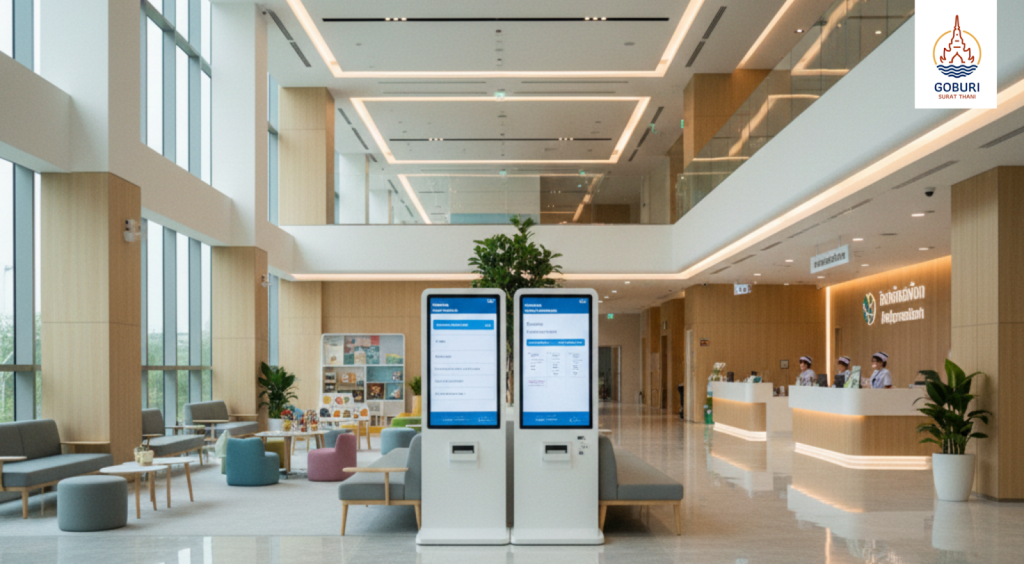
Accessing Private Care: Families primarily utilize Bangkok Hospital Surat or Thaksin Hospital. These facilities provide English-speaking staff and dedicated pediatric wings. A standard consultation with a pediatrician typically costs between 800 THB and 1,500 THB, which is significantly lower than the 2,500 THB+ starting rates in more tourist-heavy provinces.
Insurance vs. Out of Pocket: For a family of four, local private health insurance premiums in 2026 range from 60,000 THB to 120,000 THB annually, depending on coverage limits. Many families opt for a high-deductible plan to cover emergencies while paying out of pocket for minor issues like ear infections or flu tests, which usually total less than 2,500 THB per visit, including medication.
Pharmacy and Minor Ailments: Local pharmacies in Surat Thani are well-stocked with international brands. Common family essentials like children’s paracetamol, electrolyte salts, or antibiotic creams are highly affordable, with most basic treatments costing between 100 THB and 400 THB.
Regional Comparison with Phuket and Samui
Choosing the mainland over the islands offers a structural shift in how your budget is allocated. While the infrastructure in Surat Thani is comparable to Phuket with modern malls, international schools, and private hospitals, the cost of entry is lower because you are not competing with short-term tourists for resources.
The following table demonstrates the financial and lifestyle differences between the mainland and the island hubs.
Mainland vs Island Living Comparison (2026)
[Graphic image]
The “Price Gap” Bar Chart: A visual comparison of 3-bedroom rental prices in Surat Thani vs. Phuket and Koh Samui to highlight the 30%–50% savings.
Feature
Surat Thani (Mainland)
Phuket / Koh Samui (Islands)
3 Bedroom House Rent
18,000 to 35,000 THB
45,000 to 90,000+ THB
Monthly Total Budget
85,000 to 110,000 THB
140,000 to 180,000+ THB
Housing Cost Saving
30% to 50% lower
High touristic premium pricing
Market Competition
Stable and domestic-focused
Volatile and tourism-dependent
Traffic and Logistics
Low congestion and wide roads
High seasonal traffic congestion
Community Feel
Authentic Thai local integration
International tourism-centric
Sample Monthly Budget Scenarios for 2026
[Graphic image]
The Monthly Budget Pie Chart: A breakdown for the “Balanced Mid-Range Budget” (107,500 THB), showing the proportion spent on education, housing, and food.
To help finalize your planning, we have outlined two realistic monthly budget scenarios for a family of four (2 adults, 2 children) living in Surat Thani in 2026.
Expense Category(Family of four – 2 adults, 2 children)
Balanced Mid-Range Budget
Lean Integration Budget
Housing (3-Bed Detached)
25,000 THB
18,000 THB
Education (2 Children)
50,000 THB (International)
20,000 THB (Bilingual/Private)
Groceries & Food
20,000 THB
14,000 THB
Utilities & Internet
6,500 THB
4,500 THB
Transportation (Car)
6,000 THB
4,500 THB
Total Monthly
107,500 THB
61,000 THB
Contingency Planning: We recommend maintaining an emergency fund of at least 200,000 THB. This covers major vehicle repairs, unexpected medical deductibles, or emergency flights if needed.
Final Assessment for Prospective Residents
The cost of living in Surat Thani for families represents one of the most balanced value propositions in Southern Thailand. The primary financial trade-off is the absence of immediate beachfront living; however, the savings generated by staying on the mainland allow for frequent island weekend trips without compromising your monthly stability.
If you are ready to take the next step, we recommend a “reconnaissance trip” specifically focused on the Khun Thale and Makham Tia neighborhoods. Spend time visiting at least two international schools and touring a few gated communities to see if the pace of mainland life matches your family’s long-term goals.