We occasionally share updates when important information changes or new long-form guides are published. Just practical updates related to long-term living in Surat Thani and Southern Thailand.
The migration patterns of why some families leave from Surat Thani often center on a recurring tension between the idealized tropical lifestyle and the pragmatic requirements of long term family stability. In the province of Surat Thani, which encompasses the mainland city as well as the world famous islands of Koh Samui and Koh Phangan, this tension is most visible within the sphere of Surat Thani education.
Families frequently arrive with high expectations of a slower pace of life, yet they find that the educational infrastructure often reaches a ceiling as children approach their teenage years. This report serves as a high trust filter within the broader discussion education in Surat Thani, designed to help parents build realistic expectations and prevent regret driven decisions.
The decision to relocate is rarely triggered by a single event. Instead, it is the result of a cumulative process where the charm of island or provincial life begins to fade in the face of systemic challenges.
For international residents, the primary driver is often the limitation of international schools on Koh Samui and Koh Phangan when it comes to higher level academic preparation. For local Thai families, the move is often motivated by the perceived need for more competitive university pathways and the prestige associated with elite institutions in Bangkok.
While the region excels in early years and primary schooling, the options for comprehensive secondary programs remain narrower than in metropolitan hubs, creating a natural exit point for those seeking global competitiveness.
Infrastructure Fatigue and the Erosion of Local Romanticism
A critical factor in the relocation of all families is what can be termed infrastructure fatigue. For many new arrivals, the initial experience of Koh Phangan or Koh Samui is one of profound freedom. Many view the lack of formal systems as a liberating escape from the bureaucratic rigidity of urban life. However, as children grow, the lack of reliable utilities shifts from being a quirky detail to an exhausting disruption for both Thai and foreign parents.
The reality of living in provincial or island settings involves managing frequent power outages that can last for hours or even days. For a parent, these outages are not an adventure but a significant disruption to nap schedules and domestic routines.
Furthermore, educational infrastructure projects are often unpredictable. There are recorded instances of roads being dug up and left unfinished for two years, forcing families to literally rock climb into their own homes. When these environmental factors are combined with the seasonal monsoon rains that flood roads and shutter local businesses, the “paradise” narrative begins to dissolve for everyone.
Infrastructure Category
Initial Family Perception
Long Term Parental Reality
Impact on Retention
Power Grid
Romantic or rustic charm
Disruption to remote work and cooling
High attrition for digital nomads and professionals
Road Conditions
Adventurous scooter paths
Significant safety risks for children
Movement toward car ownership or relocation
Internet Access
Opportunity to unplug
Professional instability and isolation
Economic pressure to move to mainland or Bangkok
Public Spaces
The beach as a playground
Lack of parks, sidewalks, and bike paths
Boredom and restricted mobility for teens
Waste Management
Part of the rustic charm
Environmental health and safety concerns
Long term respiratory and hygiene anxiety
The safety of the environment is another area where perceptions shift over time. While the province is generally safe in terms of violent crime, the lack of standardized safety regulations leads to a high frequency of accidents.
Witnessing the results of reckless driving and the absence of sidewalks makes the environment feel increasingly high risk as children become more independent. Families who seek a “cared for” atmosphere with parks and gardens often find themselves looking toward destinations like Valencia, Japan, or even the gated communities of Bangkok like Nichada Thani.
The Secondary Education Ceiling and Academic Rigor
Perhaps the most significant reason for families leaving Surat Thani is the perceived and actual limitation of secondary education limitations. While parents may find small international primary schools sufficient for early development, the requirements for university entry demand a level of depth that many local institutions struggle to provide.
The Educational Migration to Bangkok
For Thai families, the move toward Bangkok is often driven by a lack of confidence in the provincial public school sector. The phenomenon of Bangkokization describes how regional centers are losing their most ambitious families to the capital, which offers world class international education and specialized test prep services.
Thai parents from the middle to high socio-economic status often prioritize school choice as a means of ensuring their children can compete for spots in top tier local universities like Chulalongkorn or Mahidol, as well as prestigious overseas institutions.
The Island Educational Bottleneck
Koh Phangan provides a prime example of this educational bottleneck for the international community. Si Ri Panya International School is a key provider on the island, but its secondary program has historically focused on Key Stage 3 and Key Stage 4.
For students aged 11 to 16, the school provides a solid Cambridge curriculum leading to IGCSE examinations. However, the absence of a comprehensive Sixth Form for Year 12 and Year 13 has traditionally meant that families must either move off the island or transition to boarding schools as their children reach the age of 16.
This lack of curriculum depth acts as a major catalyst for educational migration. Families who initially intended to stay indefinitely often find themselves planning an exit as their child approaches the end of primary school. The realization that the island cannot support a child’s education through to university entrance creates a definitive expiration date for many residencies.
Special Educational Needs and the Resource Vacuum
A deeply personal and often overlooked reason for families leaving Surat Thani is the lack of support for special educational needs (SEN). For a family with a neurodivergent child, the province can be a difficult environment to navigate.
The absence of specialized SEN institutions means that families with children who have complex behavioral or learning challenges often find themselves excluded from mainstream systems.
In fact, many schools explicitly reserve the right to refuse admission if they feel they cannot meet a child’s specific needs. This lack of inclusivity creates a “forced exit” for families who require speech therapy, occupational therapy, or educational psychology services that are simply not available locally.
Even when support is available, it often requires families to seek external assessments from professionals based in Bangkok or overseas. This adds a significant financial and logistical burden. The emotional toll of seeing a child struggle without adequate support is a powerful motivator for families to relocate to urban centers where specialized services are integrated into the school systems.
The Loneliness Epidemic and Domestic Stress
Recent data highlights a growing mental health crisis that affects all families in Thailand, regardless of nationality. Research reveals that nearly a third of young people in Thailand report persistent feelings of loneliness and isolation.
Relationship based stress within the home has escalated significantly, with experts suggesting that a lack of meaningful connection and a breakdown in communication between children and caregivers is a primary driver.
In the context of Surat Thani, this social isolation can be amplified by the transient nature of the community. In international school circles, teenagers frequently lose their closest friends to relocation, leading to a sense of social instability.
For Thai families, the pressure to achieve academic success can lead to a “happiness deficit” where children feel disconnected from their parents’ values. This “loneliness epidemic” often prompts families to move to cities like Bangkok, where larger social networks and more diverse extracurricular activities can provide a more robust support system for developing adolescents.
The Economic Realities and the Cost of High Trust Living
One of the most persistent myths about moving to Surat Thani is that it is a low cost destination for all families. While everyday expenses like street food and domestic help are affordable, the cost of maintaining a high quality of life is substantial.
When families factor in international school tuition, private healthcare, and the cost of imported goods, the financial advantage often disappears.
Expense Item
Estimated Annual Cost (THB)
Contextual Factor
Tuition (Secondary)
350,000 to 900,000
Increases as child ages
Private Health Insurance
50,000 to 150,000
Essential for specialist access
Housing (3-4 Bedroom Villa)
600,000 to 1,200,000
High quality specs are costly
Imported Groceries
150,000 to 250,000
Crucial for specific diets
Visa and Administration
30,000 to 60,000
Includes student and guardian visas
For local Thai families, the economic driver for leaving is often related to future earnings. Studies show that the behavior and skills learned in international or elite urban schools provide a much higher chance of working in multinational companies with higher salaries.
Consequently, the high cost of education is viewed as a necessary investment for the family’s long term social mobility and the parents’ own retirement security.
Environmental Health and the Struggle for Wellness
Environmental factors play an increasingly large role in the decision to leave. While the air in Surat Thani is often cleaner than in Bangkok, families still face issues with seasonal pollution and waste management.
Additionally, the prevalence of stray dogs is a significant pain point for many. Walking a pet or a small child in certain neighborhoods can be a stressful experience due to the risk of dog attacks.
The struggle for wellness also extends to the diet. While Thai food is world famous, the local commercial diet is often high in sugar, salt, and fish sauce. Families who prioritize organic, clean eating often find themselves spending a premium to avoid the health consequences of the local diet.
Over time, the effort required to maintain a healthy lifestyle in an environment that does not naturally support it leads to a state of burnout.
The Exit Strategy: Moving Toward Reliable Systems
The case of families leaving the islands after many years illustrates the transition from “paradise” to practicality.
Many residents eventually seek the very systems and structures they once tried to escape: reliable healthcare, working postal services, and predictable infrastructure. The realization that a child is outgrowing the environment is the most powerful signal for relocation.
The relocation risks are often tied to the lack of property rights for foreigners and the lack of competitive academic environments for locals. When parents start thinking about long term financial stability and university entrance, the province’s limitations become dealbreakers. Families begin to crave roots and predictability, leading them to look toward Bangkok or international destinations like Europe or Japan.
Regional Comparison: The Lure of Phuket and Bangkok
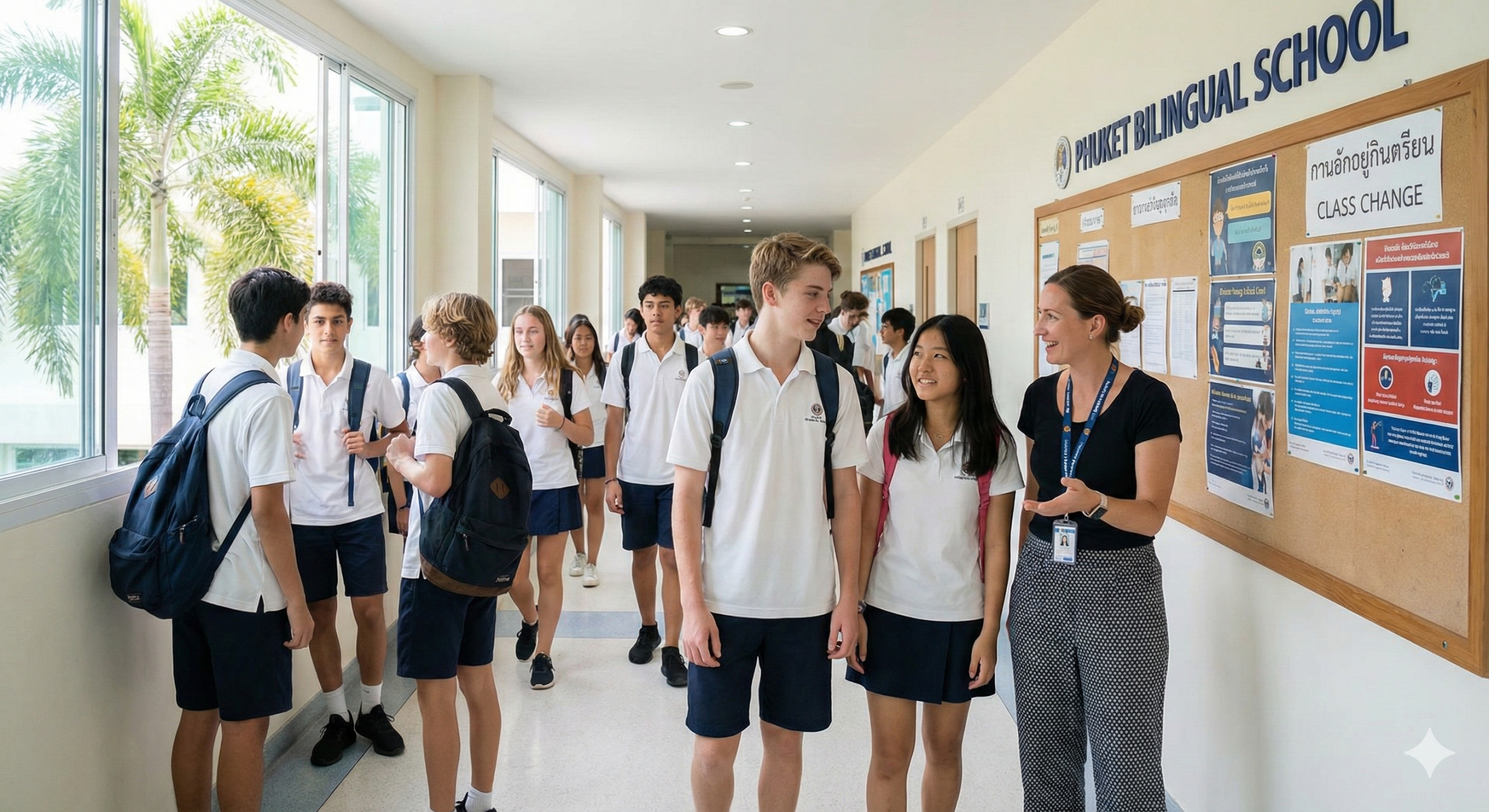
For families who are not ready to leave Thailand but have reached the limits of Surat Thani, the move is often internal. Phuket and Bangkok are the primary destinations, offering a “best of both worlds” scenario with world class infrastructure.
Phuket and Bangkok’s advantages include:
Curriculum Diversity: Families can choose between the IB Diploma, British A-Levels, and American high school diplomas.
Specialist Healthcare: JCI accredited hospitals provide comprehensive care, including specialized pediatric units, that eliminate the need for medical evacuation.
Elite Lifestyle Amenities: Access to global brands and high quality public parks provides a level of convenience absent in Surat Thani.
Campus Scale: Schools feature sprawling, university style campuses with Olympic standard facilities.
Actionable Recommendations for Families
To avoid the regret driven decisions that lead to relocation, families must enter the local market with a clear understanding of. The goal of this educational silo is to filter families early, ensuring that those who choose to stay are prepared for the challenges.
Perform a Five Year Audit
Before committing to long term residency, parents should project their child’s educational needs five years into the future. If the family is not comfortable with the secondary options or university pathways available as the child turns fifteen, the stay should be viewed as a temporary chapter.
Assess Health and SEN Requirements
Families with any history of chronic health issues or learning difficulties should conduct a thorough site visit of local medical facilities and school SEN departments. It is vital to verify the availability of specific therapists and specialized equipment before signing long term leases or school contracts.
Establish a Financial Safety Net
The “real” cost of living should be calculated using Western or Bangkok parity for healthcare and education. Families must ensure they have the financial liquidity to afford medical evacuations or mid year school transfers if the local environment proves unsuitable for their evolving needs.
The Maturity of the Residency Cycle
Relocation from Surat Thani is not a sign of failure but rather a sign of a family’s success in navigating one stage of life and their readiness for the next. The province offers a unique, nature focused environment that is unparalleled for early childhood development. However, the educational glass ceiling and the erosion of infrastructure stability mean that for many, provincial life has a natural shelf life.
By acknowledging the secondary education limitations and the relocation risks early, parents can make informed choices that prioritize their child’s long term success over short term aesthetics.
Whether the journey leads to a permanent home in the Gulf of Thailand or a move toward the more robust systems of Bangkok or overseas, the decision must be rooted in a high trust understanding of the local reality.
Surat Thani remains a world class destination for those who understand its boundaries, but for those who seek a lifelong, all encompassing system of support, the search often leads elsewhere.