We occasionally share updates when important information changes or new long-form guides are published. Just practical updates related to long-term living in Surat Thani and Southern Thailand.
The regional housing landscape of Southern Thailand is currently characterized by a significant economic divergence between the mainland and the surrounding islands. For individuals and families considering housing in Surat Thani, the decision to engage in long term vs short term rentals is the most critical factor in determining their financial stability and local integration.
While destinations like Koh Samui and Koh Phangan operate on a tourism-centric model where property prices are untethered from local wages, the Surat Thani mainland remains grounded in a domestic economy. This structural difference provides a “Mainland Discount” that allows professional residents to access high quality accommodation at a fraction of the cost found in more tourist heavy provinces.
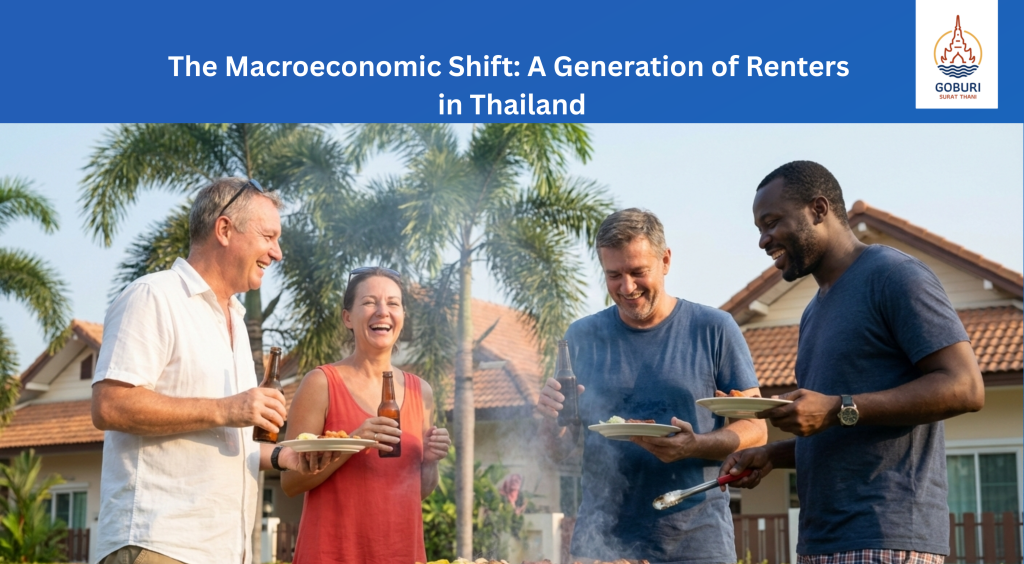
The Macroeconomic Shift: A Generation of Renters in Thailand
The broader context of the Thai property market suggests a fundamental shift in consumer behavior that directly impacts the availability and pricing of housing in Surat Thani.
Recent data indicates that high levels of household debt and stricter lending criteria from financial institutions have created a “generation of renters” among Gen Z and Gen Y demographics.
In Surat Thani, this demand manifests in a market that is increasingly professionalized. Unlike the speculative bubble often seen in vacation destinations, the mainland rental sector is supported by a stable population of civil servants, educators, and healthcare professionals.
This stability ensures that long-term rentals remain predictable and that the wild seasonal price swings associated with the “High Season” on the islands are largely absent.
For an expat, this means that a rental contract signed in January is likely to carry the same value and terms as one signed in July, providing a level of budgetary certainty that is rare in the hospitality-driven markets of Phuket or Samui.
Comparative Market Overview: Mainland vs. Island Dynamics
The tangible financial leverage gained by living on the mainland is best illustrated by comparing the median rental rates across the province.
The following data highlights the cost-efficiency of the Surat Thani urban core and its surrounding suburbs compared to the luxury markets of the islands.
Location
1-Bedroom (Avg Monthly)
3-Bedroom (Avg Monthly)
Focus of the Market
Surat Thani City
8,000 to 12,000 THB
18,000 to 25,000 THB
Domestic / Long-term
Koh Samui
35,000 to 55,000 THB
120,000 to 180,000 THB
Tourism / Luxury
Koh Phangan
25,000 to 45,000 THB
80,000 to 130,000 THB
Wellness / Nomad
Phuket
18,000 to 30,000 THB
55,000 to 90,000+ THB
Global Tourist
The figures above demonstrate that a high quality 3-bedroom detached house in a mainland gated community can often be secured for less than the cost of a basic studio apartment in a prime Samui beach area.
This discrepancy is a primary reason why many long-stay residents choose to use Surat Thani as a “launchpad” for the region, enjoying mainland costs while visiting the islands for short excursions.
The Strategic Framework for Short-Term Rentals
The market for short-term rentals in Surat Thani is primarily defined by flexibility and move-in readiness. This segment caters to digital nomads, business travelers, and those who are in a transitional phase of their relocation.
In the context of housing in Surat Thani, short-term stays are generally defined as any duration under six months, though the legal definition often hinges on the 30-day mark.
The Legal Realities of the Hotel Act
A major point of confusion for many foreigners is the legality of Airbnb and similar platforms in Thailand. Under the Hotel Act B.E. 2547, providing accommodation for fewer than 30 days in exchange for compensation is considered a hotel business.
Properties operating in this manner are required to hold a hotel license and meet stringent safety and administrative standards. For most condominiums, the “juristic person” or building management strictly prohibits rentals of fewer than 30 days to protect the privacy and security of long-term residents.
However, there are specific exemptions that have been clarified in recent years to support small-scale tourism. If a property has fewer than eight rooms and can accommodate no more than 30 guests, it may be exempt from the full hotel license requirement, provided it registers as a “non-hotel” accommodation with the local authorities.
Despite these exemptions, many individual condo owners continue to operate in a legal gray area. For the tenant, the risk of staying in an unlicensed short-term rental includes potential friction with building staff or being asked to leave the premises if management decides to enforce building bylaws strictly.
Serviced Apartments: The Turnkey Hybrid
For those who require the flexibility of short-term rentals without the legal ambiguity of unlicensed condos, serviced apartments are the optimal solution. These establishments are professional operations that combine the amenities of a hotel with the layout of a traditional apartment.
The primary advantage of a serviced apartment is the all-inclusive nature of the monthly fee. Unlike long-term rentals where the tenant must set up accounts with the Provincial Electricity Authority (PEA) and various internet providers, a serviced apartment bundles these costs into a single payment. This makes budgeting highly predictable and eliminates the need for large upfront security deposits.
Key features of serviced apartments include:
Lease Flexibility: Many offer weekly or month-to-month contracts, allowing for easy departure if professional circumstances change.
Move-In Readiness: Units are fully furnished with linens, kitchenware, and appliances, reducing the initial setup cost to zero.
On-Site Services: Housekeeping, laundry services, and 24-hour security are standard, which is particularly beneficial for busy professionals.
Simplified Utility Billing: While the base rent is higher, the lack of separate utility bills and maintenance fees often balances the total monthly expenditure for stays of three months or less.
When evaluating housing in Surat Thani, it is important to note that serviced apartments in the city center typically range from 14,000 THB to 22,000 THB per month, which is a significant premium over the 8,000 THB to 12,000 THB one might pay for a standard unserviced condo.
The Infrastructure of Long-Term Rentals
For residents planning to stay in the province for a year or more, long-term rentals are the most cost-effective and legally secure option.
This segment of the market is built on the foundation of the Thai Civil and Commercial Code, which grants tenants significant rights while demanding a greater degree of responsibility for the property.
The 2025 Consumer Protection Update (B.E. 2568)
The most transformative change in the long-term rentals sector is the Notification of the Contract Committee Re: Designating the Residential Property Leasing Business as a Contract-Controlled Business B.E. 2568 (2025). Effective as of September 4, 2025, this regulation was designed to curb predatory practices by landlords and property management companies.
One of the most critical aspects of this update is its expanded scope. The law now applies to any landlord who leases three or more residential units, a reduction from the previous threshold of five units. This means that many more “small” landlords in Surat Thani are now legally required to follow standardized contract terms. For the expat community, this provides a level of legal recourse that was previously difficult to access.
Mandatory Terms and Prohibited Clauses
Under the 2025 regulations, a compliant residential lease must adhere to several strict requirements to ensure fairness for the tenant.
Requirement
Description of the Law
Benefit to the Tenant
Deposit Caps
Combined total of security deposits and advance rent cannot exceed 3 months of rent.
Reduces the high upfront capital required to move in.
Utility Rates
Landlords must charge electricity and water at the official provider/government rates.
Prevents landlords from profiting on utility surcharges.
Invoice Timing
Written invoices for rent and utilities must be delivered at least 3 days before the due date.
Provides transparency and time to inspect calculations.
Deposit Return
Must be returned immediately at lease end, or within 7-14 days if an inspection is required.
Ensures prompt recovery of funds for the next move.
Entry Rights
Landlords cannot enter the premises without prior notice, except in emergencies.
Protects the tenant’s right to privacy and quiet enjoyment.
Early Termination
Tenants can end a fixed-term lease early after occupying it for 50% of the term.
Provides a legal exit strategy with only 30 days of notice.
These regulations are particularly relevant for those researching renting as a foreigner as they clarify the standard protections that apply regardless of nationality. It is vital to ensure that any contract signed mirrors these requirements. If a landlord includes a clause allowing them to seize the deposit without fault or charge inflated electricity rates, that clause is legally void under the 2025 notification.
The Standard Lease Structure
In the Surat Thani market, the standard long-term rentals agreement is for 12 months. The typical financial commitment involves the “2+1” model: a security deposit equal to two months of rent plus the first month’s rent paid in advance.
While some luxury villas on the islands might request a larger deposit, the 2025 law strictly limits this for residential properties on the mainland.
Tenants should be aware that the responsibility for repairs is typically divided between “major” and “minor” items. Standard practice dictates that any issue arising from non-direct causes, such as a failing refrigerator compressor or structural plumbing leaks, is the landlord’s responsibility.
Conversely, minor wear and tear or damage caused by the tenant’s actions are usually the tenant’s burden.
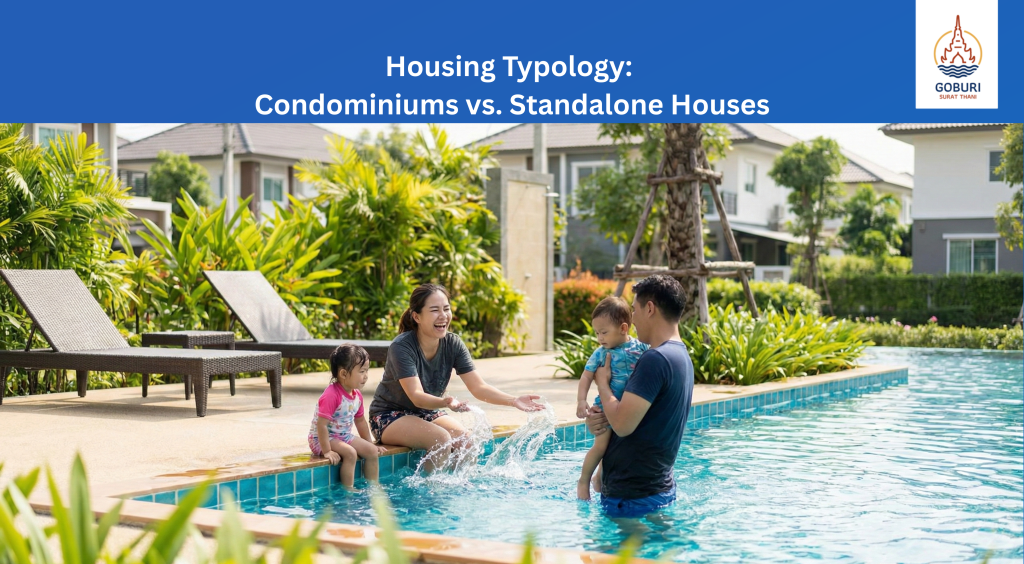
Housing Typology: Condominiums vs. Standalone Houses
The physical environment of housing in Surat Thani (houses vs condos) is roughly divided between urban high-rise or low-rise condominiums and suburban gated communities, often referred to as “Moo Baans.” Each type offers a different set of trade-offs regarding privacy, maintenance, and community.
The Appeal of Modern Condominiums
Condominiums are the preferred choice for single professionals and digital nomads who value amenities and security. Because each unit in a condo is individually owned, the interior decoration and maintenance standards can vary significantly between two units in the same building.
The primary benefits of condo living include:
Facilities: Access to a swimming pool, gym, and often a co-working space is included in the rent.
Security: 24-hour security guards and CCTV systems provide a high degree of safety.
Direct Utility Billing: Condo residents typically pay their electricity bills directly to the PEA, ensuring they receive the government rate without mark-ups.
Minimal Maintenance: The tenant is only responsible for the interior of the unit, while a “juristic person” manages the common areas and structural repairs.
Gated Communities: The Family Choice
For those seeking more space and privacy, the detached houses within gated communities offer the highest quality of life on the mainland. These estates are designed for permanent residency and often feature perimeter gardens and private carports.
However, house living requires a more proactive approach to maintenance. For example, the tenant or landlord must manage garden upkeep and pest control, which are not concerns in a condo.
Many families in Surat Thani budget approximately 6,000 THB to 10,000 THB annually for professional pest control services to protect against termites and ants, which are prevalent in the tropical climate.
Utility Costs and Management (CAM) Fees
A unique aspect of living in a “Moo Baan” is the utility costs associated with Common Area Management (CAM) fees. This covers the security of the estate, street lighting, and garbage collection. While many landlords include this in the monthly rent, it is essential to verify this in the contract.
If the fee is passed to the tenant, it is typically calculated based on the “Square Wah” (one square wah equals four square meters). For the 2026 market, rates range from 20 to 50 THB per square wah per month.
For a standard 60 square wah house, this results in a monthly fee of approximately 1,200 to 3,000 THB. Most juristic offices require residents to pay these fees for twelve months in advance, resulting in an annual lump sum of 14,400 to 36,000 THB.
Financial Realities: The Cost of Living in Surat Thani
One of the most profound insights for residents is that the advertised rent is often the starting point of their housing budget. The tropical climate of Southern Thailand necessitates a high degree of utility management, particularly regarding electricity and water quality. It is important to calculate the cost of living in Surat Thani carefully before moving.
The Dynamics of Electricity Usage
Electricity is consistently the most variable expense for a solo resident or a family. The cost is driven primarily by air conditioning habits. In 2026, the government rate remains approximately 3.88 THB per unit, but the total monthly bill can fluctuate wildly.
A critical maintenance insight is that humidity causes air conditioning units to lose efficiency rapidly. A unit that has not been professionally cleaned in six months can consume up to 20% more power to maintain the same temperature. Smart residents budget for a deep chemical clean every six months, which typically costs between 600 and 1,000 THB per unit.
Water Management and Filtration
Tap water in the province is treated but is not considered potable by international standards. Residents typically choose between two strategies for clean drinking water. The most common is the delivery of 18-liter white bottles, which are inexpensive at 15 to 25 THB per bottle but involve significant logistical friction.
Alternatively, many long-term residents invest in an undersink reverse osmosis (RO) filtration system, which costs between 8,000 and 15,000 THB. This investment pays for itself within 12 to 18 months and provides the convenience of unlimited clean water without the need for frequent deliveries.
Geographic Strategy: Neighborhood Dynamics
The choice of best areas to live in is inextricably linked to the desired lifestyle and proximity to essential services.
Makham Tia: The Green Suburb
Makham Tia is widely regarded as the most desirable neighborhood for the city’s professional and expat community. It offers a balance of traditional Thai culture and modern infrastructure.
The area is known for its lush greenery and serene atmosphere, making it a peaceful retreat from the urban core. Because it is slightly removed from the dense center, families can often find larger detached houses with gardens for a similar price to smaller townhouses in the city.
Khun Thale: The Academic and Family Hub
Khun Thale has become the primary hub for expat families, largely due to its proximity to reputable international schools and the local university. The cost of living is often optimized in this area, with rents running approximately 15% to 20% lower than city center equivalents.
The neighborhood provides a strong sense of community and easy access to the scenic Khun Thale Lake, which is a popular spot for evening exercise and recreation.
Immigration Logistics: The TM30 Reporting Imperative
Regardless of whether a resident chooses long-term rentals or short-term rentals, they must comply with the mandatory address notification system known as TM30 reporting. This regulation, based on the Immigration Act B.E. 2522, requires property owners to report the stay of any foreigner within 24 hours of their arrival.
The Shared Consequence Framework
A common misconception is that because the landlord is legally responsible for filing the TM30, the tenant does not need to worry about it.
However, the Thai immigration system operates on a “shared consequence” model. If there is no valid TM30 record on file for a resident’s current address, they will likely face rejection when applying for visa extensions, performing 90-day reports, or obtaining a residence certificate for a driver’s license.
Step-by-Step Reporting Process
Most professional landlords use the official online portal or the “Section 38” mobile application to submit these reports instantly.
If a landlord refuses to file the report, the tenant can legally file it themselves at the Surat Thani Immigration Office by providing a copy of the rental agreement and the landlord’s contact details.
The mainland immigration office is located in the Kanchanadit district, specifically at 41 / 12 Moo 2, Tambol Tungrang. It operates Monday through Friday from 8:30 AM to 4:30 PM.
Negotiating the Best Terms for Your Stay
The Thai concept of “Face” and the importance of personal rapport cannot be overstated in the Surat Thani rental market. Negotiating housing in Surat Thani is less about aggressive bargaining and more about building a relationship of mutual trust and respect.
Rapport-Building and “Face”
Approaching a landlord with politeness and genuine appreciation for their property is more likely to result in a discount than a purely transactional approach.
Using formal language and learning basic Thai phrases, such as “Sawasdee khrap” (hello) and “Khob khun khrap” (thank you), demonstrates a level of respect for local culture that landlords highly value.
Negotiation Leverage Points
Lease Length: Offering a 24-month contract instead of 12 months can often secure a 10% to 20% discount on the monthly rent.
Upfront Payment: For those with the financial means, paying 6 or 12 months in advance is an extremely persuasive tool that can lead to 5% to 15% price reductions.
Tenant Stability: Highlighting your occupation, such as being a teacher or a professional at a local hospital, signals that you are a reliable and low-risk tenant.
Property Vacancy: If a property has been vacant for more than 30 days, the owner is often more motivated to negotiate on price or include additional furniture and appliances.
It is essential to get all negotiated terms in writing. Verbal agreements are rarely enforceable in the event of a dispute. A professionally drafted, bilingual contract that complies with the 2025 regulations is the best way to protect your interests.
Which Model Suits Your Lifestyle?
Choosing between short-term rentals and long-term rentals ultimately depends on your degree of commitment to the region and your appetite for logistical management.
The Case for Short-Term Tenancy
The short-term model, specifically through serviced apartments, is the correct choice for:
Digital nomads who thrive on mobility and do not wish to be anchored to a single city for more than a few months.
New arrivals who are unsure which neighborhood best fits their daily routine and wish to “test-drive” the city before signing a binding lease.
Business professionals on temporary assignments who require the convenience of all-inclusive billing and daily housekeeping.
The Case for Long-Term Tenancy
The long-term model is the superior strategy for:
Expats and retirees who intend to make Surat Thani their primary residence and wish to minimize their monthly housing costs.
Families who need the space and stability of a detached house in a secure gated community.
Individuals seeking the maximum legal protection provided by the 2025 consumer protection laws.
By understanding the “Mainland Discount” and the structural nuances of the market, residents can enjoy a high standard of living that remains insulated from the volatility of Thailand’s more tourist-focused provinces.
Whether choosing the urban convenience of a condo in Makham Tia or the spaciousness of a family home in Khun Thale, the key is to prioritize legal compliance through TM30 reporting and ensuring that all lease agreements reflect the most current standards of Thai property law.