We occasionally share updates when important information changes or new long-form guides are published. Just practical updates related to long-term living in Surat Thani and Southern Thailand.
The province of Surat Thani represents a unique intersection of Thai administrative power and southern economic vitality. For the foreign national, renting as a foreigner in Surat Thani is often a decision predicated on a desire for authenticity, strategic location, and financial efficiency.
Unlike the hyper-touristic enclaves of Phuket or the high-velocity urbanism of Bangkok, Surat Thani functions as a working provincial capital. This report provides a deep-dive analysis into the structural realities of the Surat Thani housing market, the evolution of Thai rental law, and the logistical frameworks required for a sustainable life in the region.
The Jurisprudential Landscape of Residential Leasing
The legal foundation for renting in Surat Thani is anchored in the Civil and Commercial Code of Thailand, specifically sections 537 through 571.
These statutes define a lease as a contract where one person, the lessor, agrees to let another person, the lessee, have the use of a property for a limited period in exchange for rent. It is a personal right of possession, not a real right, which has significant implications for how contracts are drafted and enforced.
Under Thai law, foreigners are permitted to enter into long term leases for up to 30 years. Any lease period exceeding this duration is automatically reduced to the 30-year limit by operation of law.
For the typical expat seeking Surat Thani housing, most residential agreements span 12 to 36 months, yet the 30-year framework provides the legal ceiling for those contemplating semi-permanent residency or the construction of a custom home on leased land.
Consumer Protection Mandates and Fair Practice
A pivotal shift in the foreigner rental rights landscape occurred with the implementation of modern notifications from the Contract Committee on Residential Leasing, issued under the Consumer Protection Act.
These regulations are designed to professionalize the rental market and curb historical abuses regarding the security deposit and utility markups. These rules apply to business operators who lease out three or more residential units, regardless of whether those units are in a single building or scattered across the province.
The mandatory standards introduced by these regulations create a safer environment for long term rental seekers. For instance, landlords classified as business operators are prohibited from collecting a security deposit or advance rent that, when combined, exceeds three months of the monthly rental fee.
Furthermore, the regulation mandates that utility charges for electricity and water must not exceed the rates billed by the relevant state authorities, such as the Provincial Electricity Authority (PEA).
Regulatory Aspect
Business Landlord (3+ Units)
Individual Landlord (<3 Units)
Security Deposit Limit
Maximum 1 or 2 months rent
Negotiable, typically 2 months
Advance Rent Limit
Maximum 1 month rent
Negotiable, typically 1 month
Early Termination Right
Allowed after 50% of term with 30 days notice
Subject to specific contract clauses
Utility Rate Cap
Must match government tariffs
Often includes a landlord markup
Deposit Return Timeline
7 to 14 days after move-out
Within 30 days or as per contract
These protections represent a significant win for the foreign tenant. In the past, it was common for landlords to inflate electricity prices or withhold deposits for cleaning fees without providing itemized receipts.
The modern reality is one of increased transparency, where the Thai rental law provides a clear mechanism for dispute resolution through the Office of the Consumer Protection Board (OCPB).
Immigration Compliance: The TM30 and Beyond
For any foreigner renting in Surat Thani, the most critical administrative task is the TM30 reporting requirement. Mandated by Section 38 of the Immigration Act B.E. 2522 (1979), the TM30 is a notification of residence that must be filed every time a non-Thai national stays at a property.
While the legal burden of filing rests with the property owner, the consequences of non-compliance often fall upon the tenant.
The Mechanism of the TM30 Form
The TM30 form notifies the Thai government of a foreigner’s current address. This is required within 24 hours of the foreigner’s arrival at the accommodation. The process is largely digitized through the Immigration Bureau’s online portal and the Section 38 mobile application.
The Receipt of Notification generated from a successful TM30 filing is a prerequisite for nearly every other immigration service. Without this receipt, a resident may find themselves unable to complete their 90-day reporting (TM47), apply for a visa extension, or secure a work permit.
Therefore, it is essential that the rental agreement includes a clause explicitly requiring the landlord to fulfill their TM30 obligations promptly.
Secondary Immigration Filings: TM47 and TM28
While the TM30 is a landlord responsibility, the TM47, or 90-day report, is the sole responsibility of the foreigner. Any resident staying in Thailand for more than 90 consecutive days must report their current address to the Surat Thani police office. This can be done in person at the office located in Kanchanadit, via registered mail, or through the official E-service portal.
Historically, the TM28 form was required whenever a foreigner moved to a different province for more than 24 hours. However, in recent years, these requirements have been relaxed. Currently, a new TM28 or TM30 is only required if the foreigner changes their permanent place of residence or returns to Thailand from abroad.
Housing Typologies: Condo vs House in the Provincial Setting
The choice between a condo vs house in Surat Thani is often a reflection of one’s stage of life and desired level of integration into the local community. The market offers a clear divide between high-density urban living and low-density suburban estates.
The Condominium: Modernity and Efficiency
Condominiums are the most popular choice for digital nomads and young professionals. They offer a lock-up-and-go lifestyle that is particularly suited for those who travel frequently between the mainland and the islands.
Security and Facilities: Most modern condos in Surat Thani feature 24-hour security, keycard access, and shared amenities such as swimming pools and fitness centers.
Legal Simplicity: Under the Condominium Act, foreigners can own condo units outright in their own name, provided the building’s total foreign ownership does not exceed 49%.
Location: Condos are typically situated near major transport hubs and shopping centers like Central Plaza, offering immediate access to the city’s commercial core.
The primary disadvantage of condo living is the limited space. Many newer developments are designed as units of 30 to 45 square meters. For those seeking more space, older buildings often provide much larger floor plans, though they may lack the high-end finishes of newer launches. For a deeper comparison of these types, you can visit our guide about Surat Thani houses and condos.
The Moo Baan: The Gated Community Experience
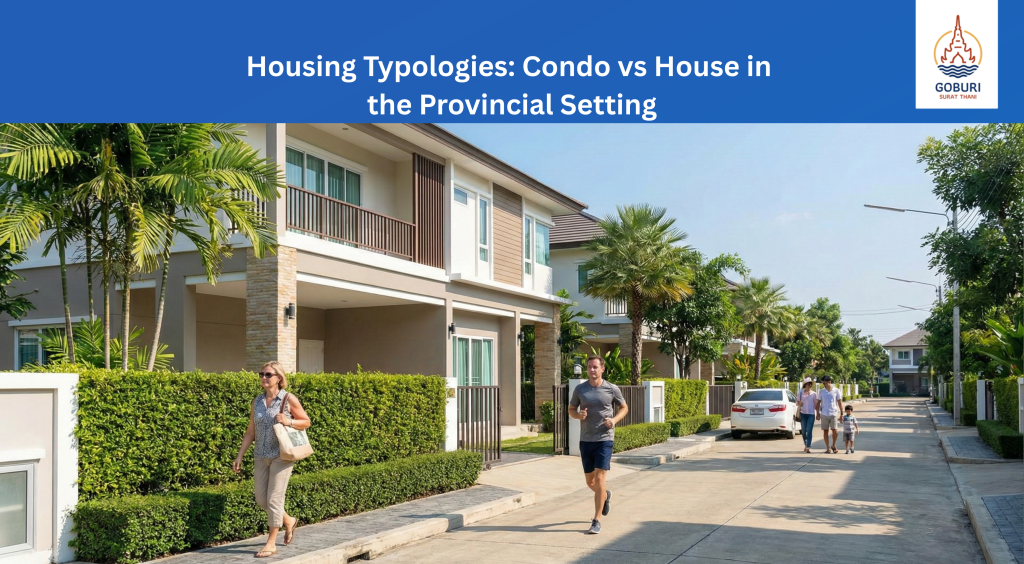
For families and retirees, the gated community, locally known as a Moo Baan, is the gold standard for Surat Thani housing. These estates offer a blend of privacy, security, and communal living.
Space and Privacy: A house in a Moo Baan typically includes a private garden and off-street parking, which is essential for those with children or pets.
Security: Like condos, these estates are often walled and gated, with security guards patrolling the grounds. This provides peace of mind in a provincial setting.
Maintenance: While the tenant is responsible for the interior and garden, the Homeowners Association (HOA) manages the common parks, roads, and security lighting.
The trade-off for this space is the increased maintenance burden. Tenants are often responsible for minor repairs and pest control, which are more frequent in detached houses due to the tropical environment. Furthermore, many of the best Moo Baans are located on the outskirts of the city, requiring the resident to own a car or motorbike for daily commuting.
Neighborhood Dynamics: A Strategic Guide to Location
Surat Thani is a decentralized city, with its infrastructure spread across several distinct sub-districts. Selecting the right neighborhood is perhaps the most important decision in the renting in Surat Thani process.
Makham Tia: The Administrative Brain
Makham Tia is the engine of the city. It contains the Surat Thani Provincial Government Center, the central police station, and major medical facilities such as Srivichai Hospital. This area is characterized by a mix of government officials, medical professionals, and students from the nearby Prince of Songkla University.
For a foreigner, Makham Tia offers unparalleled convenience. It is home to some of the city’s most established gated communities, such as Baan Sinthorn Bypass, and provides easy access to the Night Market and Central Plaza. The real estate market here is diverse, with townhouses available for rent and larger detached houses available for long term stays.
Khun Thale offers a quieter, more relaxed pace of life. The housing stock consists largely of modern Moo Baan estates that cater to families who prioritize outdoor space and a community atmosphere. Rents here are often 15% to 20% lower than in the city center for a comparable property, making it an excellent choice for those on a mid-range budget.
Ban Don and Talat: The Historic Core
The Ban Don and Talat areas represent the traditional heart of Surat Thani, situated along the Tapee River. This is where the city’s history is most visible, from the Bandon Pier to the old shop-houses that line the narrow streets.
Living here provides an immersive cultural experience. Residents have immediate access to fresh seafood markets, traditional river rituals, and a high density of local cafes. However, the housing is primarily older townhouses which may lack the modern amenities of the newer suburbs. Noise levels are also higher due to the proximity of the ferry terminals and the bustling night markets.
Phunphin: The Regional Gateway
Phunphin is located west of the city and serves as the primary transit gateway, housing the Surat Thani Railway Station and the airport. While most expats prefer to live closer to the city center, Phunphin offers a unique riverside lifestyle that is increasingly popular with retirees seeking a slower pace. It provides a more authentic, less developed environment, though it lacks the concentration of international schools and hospitals found in the Mueang district.
Financial Analysis: The Cost of Living in Surat Thani
The cost of living in Surat Thani is one of the most compelling reasons for foreigners to relocate here. The province maintains a high standard of living while avoiding the tourist tax prevalent in other parts of Thailand.
Rental Benchmarks by Property Size
Rental prices on the mainland remain remarkably stable compared to the islands. While Koh Samui has seen prices rise, the Mueang district of Surat Thani offers exceptional value for money.
Property Type
Monthly Rent Range (THB)
Location Context
1-Bedroom Condo
8,000 to 15,000
City Center (Near Central)
2-Bedroom Townhouse
12,000 to 20,000
Makham Tia / Wat Pradu
3-Bedroom Detached House
20,000 to 35,000
Khun Thale / Gated Community
Luxury Pool Villa
50,000+
Tapi River / High-end Estate
For a single professional or a digital nomad, a budget of 15,000 THB is sufficient to secure a high-quality, modern apartment. For a family of four, a budget of 30,000 to 45,000 THB allows for a spacious home in a secure estate with shared amenities. For more on budget planning, see [/housing-in-surat-thani/long-term-vs-short-term-rentals].
Utility Cost Breakdown: Electricity and Water
In a provincial setting, utility bills are manageable, provided they are managed with awareness.
Electricity: The PEA Tariff
Electricity is provided by the Provincial Electricity Authority (PEA). The rate structure is tiered, meaning the more units you consume, the higher the price per unit. The base rate for residential consumption typically reflects economic conditions to avoid placing additional pressure on households.
Residents should be vigilant about the Fuel Tariff (Ft), which is adjusted periodically to reflect global energy prices. In recent periods, the government has moved to reduce this tariff to ease the burden on residents. To ensure they are paying the fair rate, tenants should insist on seeing the original PEA bill rather than paying a flat rate to the landlord.
Most households in a modern Surat Thani housing estate will pay between 250 and 600 THB per month for water, including the monthly service fee of 30 to 50 THB depending on the meter size.
Connectivity and Digital Infrastructure
Surat Thani is one of the better-connected provinces in the south. Fiber-optic internet is standard in almost all modern housing developments. Providers such as AIS and True offer 1 Gbps connections for approximately 800 to 1,300 THB per month. Mobile 5G coverage is excellent throughout the Mueang district, with unlimited plans starting at roughly 600 THB.
The Rental Lifecycle: From Search to Move-Out
Successfully renting in Surat Thani requires a disciplined approach to the various stages of the tenancy. Foreigners who follow a standardized process are far less likely to encounter disputes over the security deposit or contract terms.
The Search and Viewing Phase
Most rentals in Surat Thani are found through a combination of online platforms like Facebook Marketplace, local real estate websites, and physically driving through neighborhoods to look for For Rent signs. When viewing a property, it is vital to inspect the engineering systems, as the tropical climate can be harsh on building components.
Air Conditioning: Test every unit for cooling speed and noise. Air conditioners that have not been cleaned recently can lead to high electricity bills.
Water Systems: Check the pressure in all faucets and look for signs of leaks or mold under sinks and in bathroom corners.
Pest Control: Ask the landlord when the last termite and pest treatment was conducted. In a provincial town surrounded by greenery, regular treatments are non-negotiable.
Negotiation and the Lease Agreement
Negotiation is an expected part of the Thai rental process. Tenants who sign a long term rental lease can typically negotiate a 5% to 10% discount on the asking price, especially if the property has been vacant for more than a month.
The lease agreement itself should be a bilingual document in Thai and English to ensure both parties fully understand their obligations. Key clauses to include are:
Maintenance Responsibility: Landlords are responsible for major structural repairs and appliance failure not caused by the tenant.
Diplomatic Clause: For working professionals, this allows for early termination if the tenant is transferred to another city or their work permit is cancelled.
Deposit Return: Specify that the deposit must be returned within a set period after move-out, minus itemized deductions for damages beyond normal wear and tear.
Move-In Documentation
On the day of move-in, a detailed inventory checklist must be completed. This should include high-resolution photos and video of the entire property, capturing the condition of floors, walls, and furniture. This documentation is the tenant’s primary defense against unfair deposit deductions when they eventually move out. Under modern regulations, a signed condition report is mandatory for many landlords.
Move-Out Protocol
When the lease term concludes, the move-out process should be handled with professional courtesy. Tenants should provide at least 30 days of notice and ensure the property is professionally cleaned.
Conduct the final walkthrough with the landlord or agent present. If the property is in the same condition as at move-in minus normal wear, the landlord is legally obligated to return the security deposit promptly. In cases where a landlord attempts to withhold money for pre-existing damage, the move-in photos provide the necessary evidence to resolve the dispute.
Why Surat Thani is the Next Big Move
As Thailand continues to attract foreigners seeking authentic alternatives to traditional expat hubs, Surat Thani is poised for steady, sustainable growth. The expansion of regional infrastructure and the continued development of the southern economic corridors are bringing more professional-grade housing to the province.
The city provides a distinct financial advantage for families, as they often receive quality instruction and facilities without the heavy luxury lifestyle premium found in more tourist-centric provinces.
For the foreign resident, this means that the inventory of modern Surat Thani housing is increasing. New condo developments and upscale Moo Baan estates are becoming more common, catering specifically to a lifestyle that blends work and leisure.
Despite this growth, the city maintains its cultural integrity, ensuring that residents remain integrated into a vibrant, working Thai society rather than isolated in an expat bubble.
This mainland strategy allows residents to enjoy the beauty of the Gulf of Thailand on weekends while living in a city that offers professional-grade amenities and local prices for daily life. As more digital nomads and retirees look for high-value, low-stress environments, Surat Thani stands out as a strategic base for long term living.