We occasionally share updates when important information changes or new long-form guides are published. Just practical updates related to long-term living in Surat Thani and Southern Thailand.
Relocating to Surat Thani represents a significant departure from the typical expatriate experience found in Thailand’s primary tourism hubs. While cities like Bangkok or Phuket have developed extensive international infrastructure and Westernized conveniences, Surat Thani remains a functional Thai provincial capital. This creates a specific form of Surat Thani culture shock for those arriving from more globalized environments.
For the long-term resident, the primary challenge is not the climate or the cuisine. Instead, it is a logistical and social adjustment. Integration here requires learning to operate within a system that does not prioritize foreign convenience. This guide analyzes the structural realities of life in Surat Thani for foreigners to help families and professionals navigate the transition from visitor to functional resident.
The information provided is designed for a Thai provincial lifestyle adjustment where the goal is stability and integration rather than a temporary vacation. Unlike curated international destinations, the urban planning and service sectors here are local-first. We believe that living in Surat Thani requires a fundamental shift in perspective, as it is a regional administrative and commercial hub that functions as the engine of Southern Thailand’s economy. Consequently, the Surat Thani expat experience is one of immersion in a working Thai city where residents must learn to operate within Thai systems rather than expecting those systems to adapt to them.
The Absence of the Expat Buffer
In highly internationalized Thai cities, there is often a distinct layer of services designed specifically to cater to non-Thais. This expat buffer includes English-speaking staff at hospitals, specialized bank branches, and real estate agencies that operate on Western administrative standards. In Surat Thani, this buffer is largely non-existent. A primary driver of Surat Thani culture shock is the sudden realization that the Surat Thani expat experience requires a direct and often unmediated engagement with local systems that were built for the Thai majority.
Infrastructure Realities
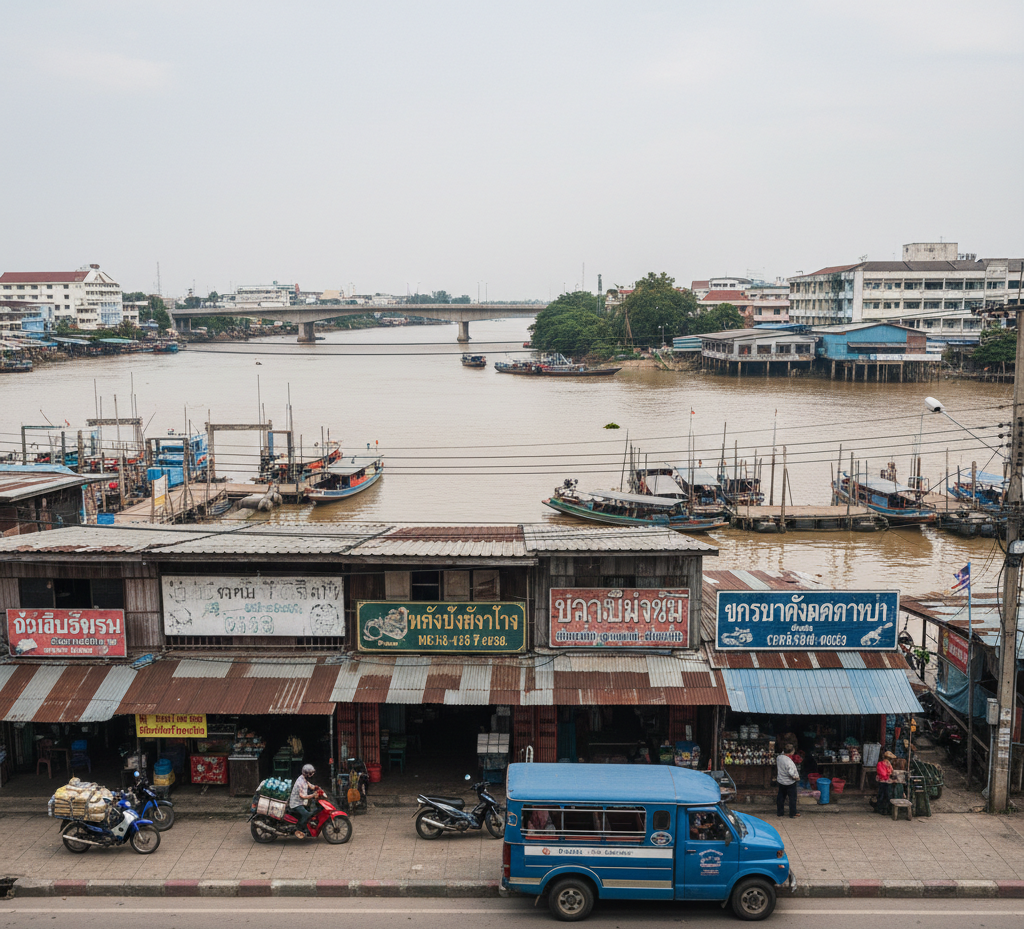
The infrastructure of Surat Thani is designed for regional commerce and local residential life rather than international tourism. While Bangkok or Phuket may offer English signage and international standard customer support for public utilities, Surat Thani operates on a local-first model. A resident experiencing Surat Thani culture shock may find that municipal notices, utility billing platforms, and even local traffic announcements are provided exclusively in the Thai language.
The Practicality of Language Dependency
When moving to Surat Thani, the acquisition of functional Thai shifts from being a cultural interest to a vital survival tool. The city does not offer a curated experience where one can live indefinitely in an English-language bubble. This lack of a linguistic safety net is a significant source of Surat Thani culture shock for many newcomers. For a long-term resident, the ability to communicate in Thai becomes essential for:
Utility Management: Discussing a sudden water leak or power outage with a local repairman who does not use translation software.
Financial Transactions: Explaining specific banking needs or clarifying insurance policy details at a local branch.
Administrative Compliance: Handling residency reporting or vehicle registration at provincial offices where procedures are explained primarily in Thai.
This language dependency is one of the most significant aspects of Thai provincial lifestyle adjustment. Without basic Thai skills, daily life can become a series of misunderstandings that lead to frustration and a sense of isolation.
Managing the Service Gap
A major component of life in Surat Thani for foreigners is navigating the service gap between Western expectations and provincial realities. Local contractors, mechanics, and small businesses typically operate through informal agreements and personal relationships rather than digital contracts. New residents often experience Surat Thani culture shock when they realize there is rarely a follow-up call from service providers. If a technician schedules a morning arrival, it is often necessary to check in with them to confirm progress. This is not a lack of professionalism but a different approach to time that prioritizes current tasks over future scheduling.
Successfully navigating these norms without Western assertiveness is a core part of mastering Southern Thai social etiquette. In Surat Thani, you are entering a system that does not prioritize foreign intuition or convenience. Everyday tasks follow a logic rooted in provincial norms and commercial functions. By acknowledging that the city does not perform for outsiders and that this friction is a standard part of Surat Thani culture shock, a newcomer can build a sustainable and integrated life in the heart of the south.
Social Integration and the Fishbowl Effect
Surat Thani is a working city where the foreign population remains small and relatively stable. Unlike the anonymity provided by the dense crowds of Bangkok or the transient nature of Phuket, being a foreigner in this provincial capital makes you highly visible. This leads to the “fishbowl effect,” where your presence is noted, and your actions are observed by the local community. For many, this visibility is a significant part of Surat Thani culture shock, as it requires a heightened awareness of one’s social conduct.
Visibility in a Working City
In a non-tourist environment, you are not seen as a temporary source of revenue but as a member of the local ecosystem. The reality of being a visible minority means that your daily routines quickly become familiar to those in your immediate area. Shopkeepers, security guards in your housing estate, and neighbors will likely recognize you within weeks of moving to Surat Thani. While this visibility is generally friendly and rooted in curiosity, it can feel intrusive to those accustomed to Western privacy standards. Understanding that this attention is a natural byproduct of a close-knit Thai community is essential for a smooth Thai provincial lifestyle adjustment.
Local Information Networks and Social Reputation
Information in a Thai provincial capital travels through informal and highly efficient social channels. In Surat Thani neighborhoods, residents maintain close social connections, and news regarding new arrivals spreads quickly through verbal communication. Your long-term reputation is a practical factor that determines the ease of your Surat Thani expat experience.
Direct social standing can impact your daily life in several ways:
Service Quality: When you are known as a polite and respectful neighbor, local tradespeople are more likely to prioritize your service requests.
Community Trust: Establishing a reputation for being calm and patient helps resolve the social friction that occurs when cultural misunderstandings arise.
Information Access: Neighbors who trust your conduct are more likely to share useful local data, such as which vendors are unreliable or upcoming changes to municipal services.
The Guest Host Dynamic
Southern Thailand is home to a traditional and conservative social hierarchy. There is a deep respect for seniority, official status, and local customs. In this environment, the Southern Thai social etiquette dictates a specific guest-host dynamic. As a foreign resident, you are viewed as a guest within their social fabric.
This dynamic has a direct impact on daily interactions. Approaching a situation with Western assertiveness or a demanding tone is often seen as a breach of this guest status. A subtle but powerful layer of Surat Thani culture shock occurs when residents mistake local politeness for a lack of rules, only to find themselves socially sidelined for being too forceful. Residents who thrive in Surat Thani are those who show deference to local leaders and elders, and who understand that their role is to integrate into the existing order rather than to challenge it. Maintaining a respectful and humble demeanor is the most effective way to ensure a peaceful and productive life in Surat Thani for foreigners and to mitigate the social friction associated with Surat Thani culture shock.
Navigating Southern Thai Communication
Mastering the nuances of local communication is perhaps the most critical skill for any resident. The way information is exchanged in a Southern Thai provincial capital differs significantly from Western standards and even from the softer communication styles of Northern Thailand. Failure to adapt to these nuances is a primary driver of Surat Thani culture shock and can lead to a complete breakdown in professional and personal relationships.
Indirect vs. Direct Communication
In Western cultures, directness is often equated with honesty and efficiency. However, in the context of Southern Thai social etiquette, bluntness is frequently perceived as a lack of emotional intelligence or even as a threat. When a resident uses high-pressure Western assertiveness to resolve a conflict, it often results in a “cessation of service.”
A common source of Surat Thani culture shock occurs when a local service provider feels cornered or overly criticized; their natural defense mechanism is to withdraw. They may stop answering phone calls or simply claim they are too busy to finish a project. For those moving to Surat Thani, it is essential to learn the art of “softening” a request. Instead of stating a problem directly, successful residents frame their concerns as a shared inquiry to maintain harmony and avoid the communication breakdown often triggered by Surat Thani culture shock.
The Concept of Saving Face
The preservation of “Face” or Greng-jai is a governing principle of social life in the south. In a professional context, causing someone to lose face by publicly highlighting a mistake can damage your social capital for years. For the uninitiated, this can be the most confusing element of Surat Thani culture shock, as it may feel like progress is being sacrificed for politeness. However, protecting the dignity of the other party is not about being dishonest; it is about maintaining the social equilibrium required for a functional Surat Thani expat experience.
Consider the following practical scenarios for navigating mistakes:
Scenario
Western Direct Approach (To Avoid)
Thai “Face-Saving” Approach (Recommended)
Incorrect Repair
“You fixed this part incorrectly; I need it redone now.”
“I think there is still a small sound here. Could you help me check if I am misunderstanding something?”
Late Delivery
“You are two days late. Why didn’t you call me?”
“I am worried about the schedule because I have another appointment. Is there anything I can do to help the process move faster?”
Administrative Error
“This form is wrong because you forgot to sign here.”
“I am sorry, I think I might have missed a signature on this page. Could we look at it together?”
Acoustics and Temperament
Newcomers often experience a specific form of sensory Surat Thani culture shock when first hearing the Southern Thai dialect, known as Phasa Tai. To an untrained ear, the local speech can sound aggressive because it is characterized by extreme speed, clipped words, and a higher volume compared to the central Thai spoken in Bangkok.
It is important to interpret this style neutrally. This staccato delivery is not an indication of anger or impatience; it is simply the regional temperament. Recalibrating your auditory expectations is a major part of a successful Thai provincial lifestyle adjustment. Recognizing that a loud, fast-paced conversation is often just a friendly exchange helps reduce the internal stress and perceived Surat Thani culture shock that many foreigners feel during their first few months in the province.
The Logic of the “Southern Pace”
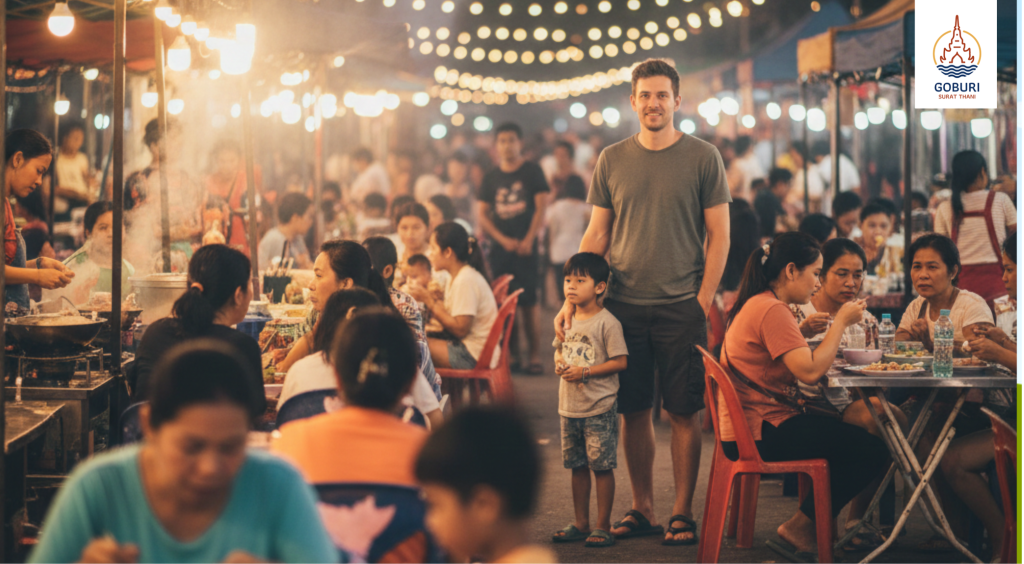
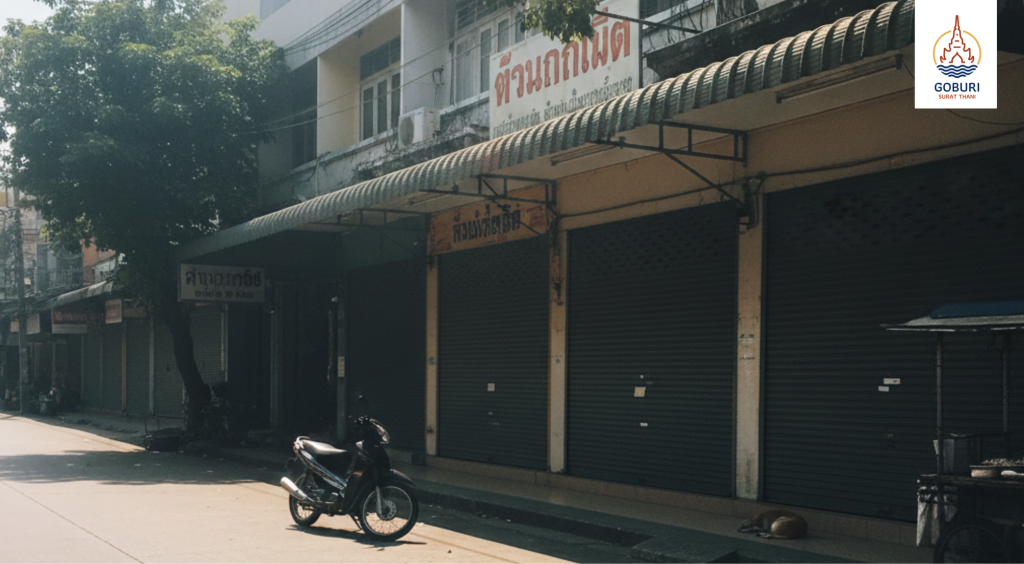
The pace of life in Surat Thani is a rational response to the environment. As a hub for rubber and palm oil industries, the city operates on a schedule that respects the tropical climate, where afternoon heat and humidity naturally slow commercial activity. A significant contributor to Surat Thani culture shock is failing to account for these daily patterns when moving to Surat Thani. Government and business activities typically begin early in the morning while temperatures are manageable, followed by a midday lull between 12:00 PM and 3:00 PM when contractors and shops are often less responsive. Activity then increases again after sunset, specifically in riverfront areas and evening markets where the city returns to a high-energy state.
Environmental and Industrial Rhythms
The pace of life in Surat Thani is a rational response to the environment. As a hub for rubber and palm oil industries, the city operates on a schedule that respects the tropical climate, where afternoon heat and humidity naturally slow commercial activity. When moving to Surat Thani, it is important to observe these daily patterns. Government and business activities typically begin early in the morning while temperatures are manageable, followed by a midday lull between 12:00 PM and 3:00 PM when contractors and shops are often less responsive. Activity then increases again after sunset, specifically in riverfront areas and evening markets where the city returns to a high-energy state.
The Fallacy of Urgency
In Surat Thani, high-pressure demands for immediate results are often met with confusion or resistance. This is because the Surat Thani expat experience involves a system where relationship building and social harmony are prioritized over speed. For those coming from high-output Western corporate environments, a significant portion of Surat Thani culture shock stems from this “Fallacy of Urgency”, the belief that a louder or more frequent demand will result in faster service.
In reality, if a bureaucratic process or a home repair takes longer than expected, the delay is often caused by the need to consult multiple parties to ensure that the work maintains “Face” for everyone involved. Pushing too hard during this period can trigger Surat Thani culture shock for the resident when the provider stops responding entirely to avoid a high-stress confrontation. Learning to wait with a “cool heart” (Jai Yen) is the most effective way to navigate the local timeline.
Logistics and Urban Realities
Surat Thani is not a city designed for pedestrian leisure or lifestyle walking. It is a sprawling and utilitarian commercial hub designed for the movement of goods, agricultural products, and the transit of the local population. Navigating the physical reality of the city is often a significant source of Surat Thani culture shock for residents who are used to the walkable neighborhoods of European cities or the organized urban planning of North American suburbs.
The Working City Layout
One of the first things a resident notices after moving to Surat Thani is the lack of a centralized and pedestrian-friendly downtown district. Because the city is a regional engine for trade, zoning is often mixed. It is common to find a quiet residential street immediately adjacent to a large rubber processing warehouse. For a resident, this means that life cannot be lived in a single neighborhood bubble. There are no distinct expat enclaves; instead, life in Surat Thani for foreigners involves being woven into the broader industrial fabric of the province.
Road Etiquette and Safety
Traffic in a provincial Thai capital is governed by a set of unwritten momentum-based rules. Understanding these laws of the road is a vital part of a safe Thai provincial lifestyle adjustment. In Surat Thani, the right-of-way is often determined by size and momentum. Larger vehicles generally expect smaller vehicles to yield. New residents must learn to drive predictably and slowly by observing the flow of local traffic rather than insisting on Western right-of-way rules.
Waste Maintenance and Public Services
What a resident should realistically expect from municipal infrastructure is often different from the manicured standards of a tourist resort. Public services in Surat Thani are functional but often decentralized, and navigating these systems is a common source of Surat Thani culture shock for new arrivals.
Waste Management: Trash collection schedules vary by neighborhood. Residents often learn the routine by observing their neighbors rather than checking a municipal website.
Maintenance: Sidewalks are often used for motorbike parking or street food stalls, which makes walking a challenge. Maintenance of public spaces is focused on functionality rather than aesthetics.
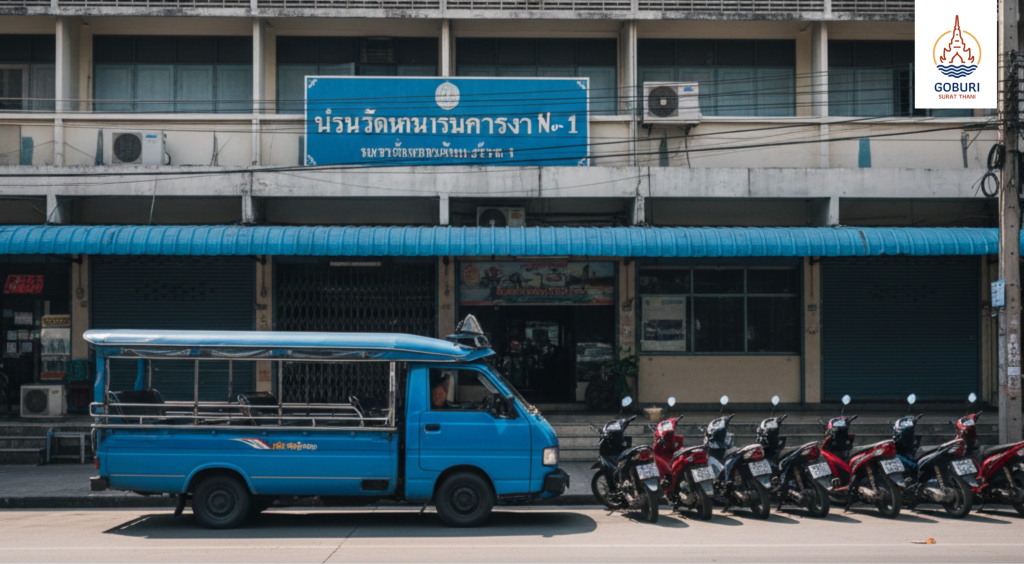
Public Transit: The city relies on songthaews and motorbike taxis. There is no mass transit rail system, so personal transport such as a car or motorbike is almost mandatory for a functional Surat Thani expat experience.
By accepting the urban reality of Surat Thani as a working hub rather than a curated destination, a resident can reduce the friction of daily logistics. The city is designed to facilitate the regional economy, and once you understand that rhythm, the initial Surat Thani culture shock and logistical frustration begin to fade.
The Family and Social Transition
For families relocating from international hubs, the lack of a pre-established expat bubble is often the most profound aspect of Surat Thani culture shock. In places like Bangkok or Phuket, social life often revolves around an international school or a specific expat club. In Surat Thani, social networks are primarily Thai, and families must be proactive to build a support system.
Social and Educational Integration
Isolation is a practical risk for remote workers or trailing spouses because Surat Thani lacks a central district where foreigners naturally congregate. Building a network requires stepping outside your comfort zone. This effort extends to the school environment, where local private and bilingual institutions operate within a traditional Thai framework. While children often achieve faster language fluency through this immersion, parents must adjust to Southern Thai social etiquette in school communications. These institutions prioritize Thai ceremonies and social hierarchies over the Western academic calendars found in Phuket or Bangkok.
Recreation Realities
Life in Surat Thani is rooted in local forms of entertainment. There is a noticeable absence of Western-style malls, luxury cinemas, or boutique galleries. Instead, family life revolves around:
Evening Markets: The social heart of the city, where families gather for food and community.
The Riverfront: A central location for exercise, festivals, and evening walks.
Adjusting to a life where entertainment is simple and nature-based is a major part of the Surat Thani expat experience. For those who enjoy a quiet, family-centric lifestyle, this transition is rewarding. For those who rely on high-energy Western entertainment, the lack of options can be a hurdle.
Practical Steps for Long-Term Adjustment
Successful integration is a gradual process that requires setting realistic expectations. It generally takes one full year of moving to Surat Thani to feel functionally integrated, as this allows you to experience the full cycle of local seasons, holidays, and business rhythms. Managing Surat Thani culture shock effectively means moving past the frustration phase and into a phase of proactive adaptation.
To facilitate this Thai provincial lifestyle adjustment and minimize the impact of Surat Thani culture shock, focus on these priorities:
Functional Thai: Prioritize practical vocabulary such as numbers for commerce, directions for navigation, and household requests for maintenance to bridge the communication gap.
Local Support: Establish a relationship with a local friend or a trusted fixer to help navigate high-stakes interactions like lease signings or utility setups.
Morning Priority: Schedule all critical banking and government visits for the first available morning slot to align with the city’s productivity rhythm and avoid heat-related fatigue.
Buffer Deadlines: Always assume that a logistical task will take twice as long as the initial estimate. This psychological buffer is your best defense against the “urgency-based” Surat Thani culture shock.
Final Considerations for the Long-Term Resident
The Surat Thani culture shock is essentially the shock of encountering an authentic and uncurated Thailand. This is a city that does not perform for outsiders, which makes it both challenging and deeply rewarding for the right type of resident. By relinquishing the expectation of a Westernized expat bubble, you gain access to a stable and more affordable way of life in the heart of the south.
The Target Resident
Surat Thani is an excellent fit for those who are patient, self-sufficient, and value relationship building over transactional speed. It is ideal for families who want their children to grow up with a global perspective and for professionals who seek a lifestyle that is not dictated by high-pressure environments. It is likely not a good fit for those who require high-end international amenities or a large foreign social circle to feel secure. The transition to life in Surat Thani for foreigners is a process of recalibrating your expectations and learning to appreciate the nuances of Southern Thai social etiquette.
FAQ
How does being a minority in a non-tourist city like Surat Thani affect daily life?
In Surat Thani, you will likely be the only foreigner in many social and commercial settings. This lack of anonymity means your actions are noticed and remembered by the local community. While this leads to a “fishbowl effect,” it also fosters a deeper sense of belonging than in tourist zones. By consistently practicing Southern Thai social etiquette and maintaining a respectful presence, you transition from being a “visitor” to a recognized and respected member of the local neighborhood.