We occasionally share updates when important information changes or new long-form guides are published. Just practical updates related to long-term living in Surat Thani and Southern Thailand.
The transition from a high frequency traveler to a long term resident in the Kingdom of Thailand represents a fundamental shift in legal status, financial obligation, and psychological orientation. While the tourism industry and social media influencers often present a curated version of the country, those who commit to multi year residency frequently encounter a different set of structural realities.
This article analyzes the most prevalent common regrets associated with living in Thailand, with a specific focus on the unique challenges and common regrets living in Surat Thani. By examining data from professional residents and logistical frameworks, this analysis provides a reality check that is essential for families and professionals planning a sustainable expat life in the region.
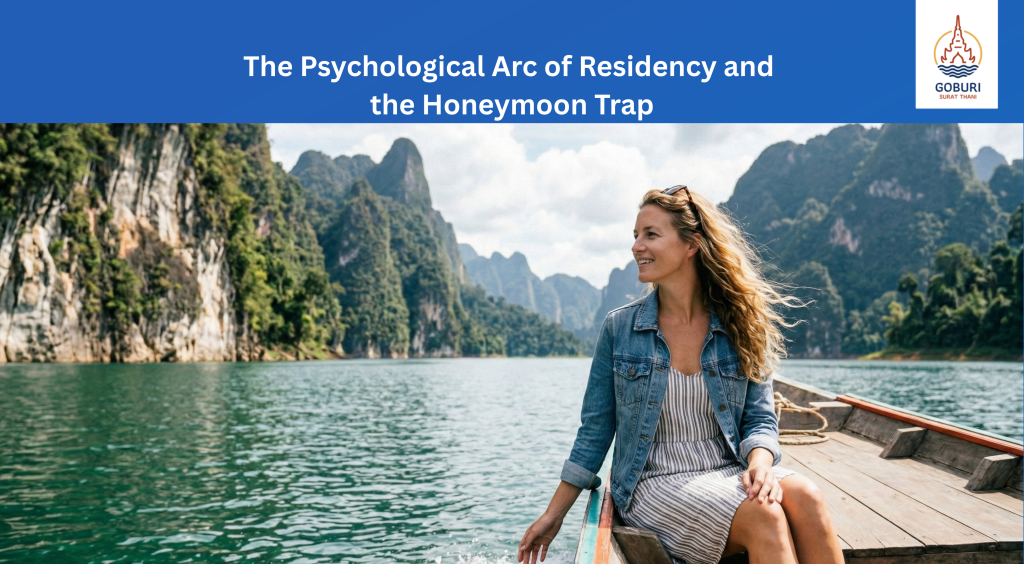
The Psychological Arc of Residency and the Honeymoon Trap
The experience of moving abroad is often defined by a predictable psychological cycle that many expats fail to recognize until they are deep within the frustration phase. For those living in Thailand, the initial euphoria is particularly potent due to the high dopamine production associated with the country’s climate, food, and perceived low cost of living.
This honeymoon stage can last for several months. During this time, the individual remains fascinated by the sights, sounds, and hospitable nature of the local population. The regret often begins when this vacation mindset persists for too long, which prevents the resident from building the necessary structural foundations, such as learning the language or establishing a legitimate financial footprint.
The expatriate adjustment cycle, originally identified by researchers like Kalervo Oberg and Sverre Lysgaard, highlights that the transition is rarely a linear path to happiness.
Instead, residents often move from initial euphoria into a period of culture shock and negotiation. This second stage is characterized by frustration and anxiety as the novelty of the environment wears off and everyday challenges become more noticeable.
Simple tasks like navigating confusing street signs or communicating in a restaurant can trigger disproportionate levels of irritation.
For many, the most significant regret is the realization that they reached a point of burnout after the honeymoon phase because they failed to anticipate the psychological toll of being a perpetual outsider.
The data indicates that those who do not actively seek to understand the underlying Thai culture are the most likely to experience a severe frustration stage.
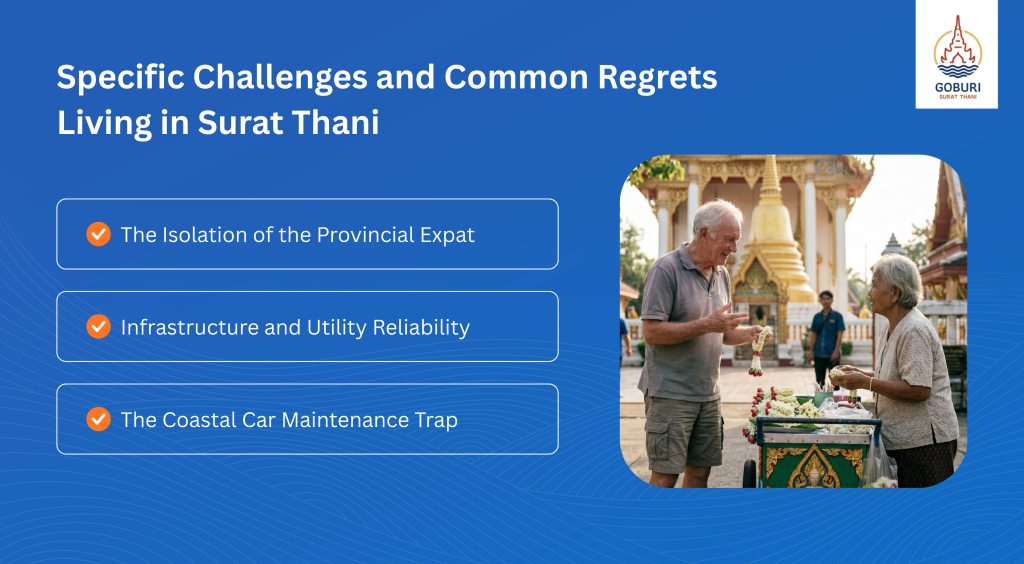
Specific Challenges and Common Regrets Living in Surat Thani
Choosing a provincial capital like Surat Thani offers a different set of trade offs compared to the expat life in Bangkok or Phuket. While many are drawn to the region for its authenticity and lower cost of living, there are specific common regrets living in Surat Thani that surface after the first year.
The Isolation of the Provincial Expat
In a non touristic city like Surat Thani, the expat life can feel significantly more isolated. Unlike Bangkok, where English is widely spoken in professional circles, daily life in Surat Thani requires a much higher level of Thai language proficiency. Residents often regret not investing in intensive language study immediately upon arrival. This lack of communication can lead to a feeling of being “trapped” in a small social circle of other foreigners or being unable to form deep connections with the local community.
Infrastructure and Utility Reliability
One of the most practical common regrets living in Surat Thani involves the city’s infrastructure during the monsoon season. The region is highly susceptible to seasonal flooding, particularly in districts like Tha Chana, Chaiya, and low lying areas along the Tapi River.
Residents often regret choosing housing based on aesthetics or proximity to a mall without researching the historical flood levels of the neighborhood.
Electricity stability is another factor that impacts long term residency. In the South, power outages can be triggered by heavy storms or even small animals interfering with overhead lines.
For remote workers, the failure to invest in a robust uninterruptible power supply (UPS) or a backup generator is a frequent source of professional frustration.
The Coastal Car Maintenance Trap
Since Surat Thani is a coastal province, the salt air and high humidity create a corrosive environment for vehicles. Residents who bring expensive imported cars often regret the decision when they see how quickly the salt particles from the Gulf of Thailand can accelerate oxidation and rust on the undercarriage.
Maintaining a vehicle in this climate requires frequent washing and specialized anti rust treatments that many newcomers overlook.
Administrative Fatigue and the Immigration Bureaucracy
The complexity and inconsistency of the immigration system are among the most frequently cited sources of regret for long term residents. Unlike a tourist visa, long term visa options require constant interaction with government systems that can feel opaque and subject to sudden change.
Residents often report that the cumulative weight of 90 day reporting, annual renewals, and the requirement for various certifications creates a sense of perpetual instability.It requires all foreign nationals to notify their residence every 90 days.
While online systems like the TM.47 portal have been introduced to streamline this process, they are often plagued by technical failures. This often forces residents to make in person appearances at crowded offices. The failure to report on time can lead to fines and complications during visa renewals, which adds a layer of administrative stress to daily life.
Comparative Analysis of Modern Visa Options
In recent years, the Thai government has introduced several high tier visa options designed to attract professionals and wealthy individuals. While these offer more stability, they come with significant financial and documentation hurdles that many expats regret not planning for earlier in their residency journey.
LTR (Wealthy Citizen): This category requires at least $1 million in global assets and extensive audit level proof.
LTR (Pensioner): Retirees aged 50 and above must show an $80,000 annual pension or stable income. This visa requires high limit health insurance.
DTV (Destination Thailand): This is designed for remote workers and digital nomads. It requires 500,000 THB in a Thai bank account but has a 180 day stay limit per entry.
Non-Immigrant O-A: This is the standard retirement visa. It requires 800,000 THB in a Thai bank account. Employment of any kind is strictly prohibited under this visa.
The regret for many retirees lies in the mandatory health insurance requirements for O-A and O-X visas. Since October 2019, insurance has been a legal necessity.
As residents age, the premiums for these visa compliant plans can become a significant portion of their monthly budget. This is often the point where residents reconsider their decision to stay because the financial barrier to residency increases annually alongside their age.
The Financial Realities of the “Luxury Trap”
A persistent myth that attracts many to Southeast Asia is that living in Thailand is universally cheap. While it is possible to live on a modest budget by adhering to local standards, many expats find that maintaining a lifestyle equivalent to their home country is surprisingly expensive.
This “luxury trap” often involves living in high end condos, frequenting international restaurants, and purchasing imported goods. All of these items are subject to high taxes and what some call “farang pricing”.
The cost of living for a professional or a family is fundamentally different from that of a backpacker. Residents must account for the depreciation of vehicles, the maintenance of air conditioning systems in a tropical climate, and the recurring costs of visa management. For many, the regret is not about the price of a bowl of noodles. Instead, it is about the hidden capital outflows that erode savings over time.
The Hidden Costs of Educational Authority
For families, the most significant expense is often the cost of international schools. The local public education system is rarely a viable option for expat children due to the language barrier and a curriculum that does not align with international standards.
Consequently, parents are forced into the private education market. Fees in Bangkok and other major cities have seen consistent inflation.
Premium institutions can cost over 1 million THB per year per child for high school students. Even mid tier schools require a significant commitment, which often ranges between $15,000 and $25,000 per year.
Many families regret moving to Thailand without a corporate package that subsidizes these costs.
The data shows that self funded families often find themselves “trapped” in a cycle where a large percentage of their remote income is diverted to tuition and associated costs like transport and uniforms. Influencers rarely mention that a world class education for children in Thailand often costs more than it does in many Western nations.
Healthcare and the Aging Pivot
While Thailand is a global hub for medical tourism, the reality for long term residents is that health insurance is a non negotiable expense.
Public hospitals are often overcrowded and have significant language barriers, which makes them difficult for many foreigners to navigate. Private hospitals offer world class care but at prices that can lead to financial ruin for those without comprehensive coverage.
One of the most profound common regrets for long term residents is the decision to remain uninsured or underinsured during their younger years. Medical inflation in Thailand is driven by an aging population and high technological costs. This means that a policy purchased today will likely be much more expensive a decade from now.
Medical Cost Comparison and Insurance Utility
Out of pocket expenses for common medical procedures in top tier Thai hospitals highlight why relying on “local prices” for serious conditions is a dangerous strategy.
Emergency Appendectomy: Estimated cost of $6,000.
Broken Leg with Surgery: Estimated cost of $11,700.
Heart Attack (ICU + Stents): Estimated cost of $28,500.
Cancer Treatment (Chemotherapy): Estimated cost can exceed $45,000.
Providers like and IMG Global offer different value propositions, but the core lesson remains that one serious accident can wipe out years of savings. Expats often regret not securing a policy that is “guaranteed renewable”. Many local plans can be cancelled by the insurer if the resident develops a chronic condition.
The Cultural Gap: Face, Kreng Jai, and Isolation
The most nuanced regrets for those living in Thailand often involve a failure to integrate into the local social fabric. Many foreigners live in an “expat bubble”. They surround themselves with other Westerners and never move beyond basic pleasantries with their Thai neighbors. This leads to a profound sense of isolation once the novelty of the culture has worn off.
The Mechanism of Saving Face
At the heart of Thai culture are the concepts of saving face (Raksa Na) and Kreng Jai. These values prioritize social harmony and the avoidance of confrontation. For Westerners who value directness and efficiency, this can be an immense source of frustration.
Many expats regret trying to apply Western management styles in a Thai workplace only to find that their staff becomes quiet and withdrawn.
A common regret involves the “Yes” that is not actually an agreement. In a face sensitive culture, a Thai person may say “yes” simply to avoid the awkwardness of saying “no” or to show that they have heard the speaker.
The expat mistakes this for a commitment only to be frustrated when the task is not completed. Understanding that this is not a lack of honesty, but rather an attempt to maintain a positive atmosphere, is key to avoiding long term bitterness.
The Loneliness of the Non Drinker
Social life in many expat hubs revolves around the bar scene. For those who do not drink or prefer to avoid the nightlife, making friends can be exceptionally difficult. This is particularly true for men, who often find it harder to form deep, non romantic connections with Thai males compared to the ease of dating.
The regret for many is that they did not invest enough time in hobbies or professional networking outside of the traditional expat social circles.
Property Ownership and the Legal Ceiling
A recurring theme in is the frustration over the inability to truly own land. Under the Land Code, foreigners are prohibited from owning land outright, with only a few rare exceptions. This creates a “legal ceiling” that can prevent residents from feeling truly settled.
The Condo Quota and Leasehold Risks
Foreigners can own 100% of a condominium unit freehold, but only if the building’s total floor area is at least 51% Thai owned. Many buyers regret not doing their due diligence and purchasing a unit in a building where the foreign quota was already full. This often forces them into a much less secure leasehold agreement.
Leasehold in Thailand is limited by the Civil and Commercial Code to a maximum of 30 years. While many developers offer “90 year leases” through a series of renewal contracts, the Supreme Court has clarified that these extensions are personal promises. They are not automatically enforceable against future owners or the Land Office.
A significant legal regret involves the use of “nominee structures”. This is where a foreigner uses a Thai national to hold land on their behalf. The government has increased its focus on these illegal workarounds.
Many expats have lost their homes and life savings when these arrangements were scrutinized during land transfers or disputes. The Sap-Ing-Sith Act was introduced to provide a more transferable right, but it still carries a 30 year limit. This remains a sticking point for those looking for generational stability.
Environmental and Health Factors
Long term residents often cite the environment as a major regret that they did not anticipate. While the climate is a primary draw, the reality of living in Thailand involves dealing with severe air pollution, particularly in the northern regions during the “burning season”.
The PM2.5 Crisis
In cities like Chiang Mai and Bangkok, the air quality index (AQI) can reach dangerous levels for several months of the year. For those with respiratory sensitivities or families with young children, this is a health crisis.
Many residents regret not choosing a location in Southern Thailand like Surat Thani where the air quality remains significantly better year round due to the sea breezes.
Traffic safety is another environmental factor that leads to regret. Thailand leads the world in road deaths per capita. The prevalence of motorbike accidents is a constant source of anxiety for parents.
The lack of pedestrian friendly infrastructure and the chaotic nature of the roads mean that residents are constantly at risk. This is a stark contrast to the safety of many Western or Northern European cities.
The Regret of the Absent Exit Strategy
Perhaps the most common regret among those who have spent 10 or 20 years living in Thailand is the realization that they never created an exit strategy. Life in the Kingdom can be so comfortable and “easy” that people often neglect their professional development or fail to maintain a financial connection to their home country.
When health fails, or when a family emergency requires a return to the West, many expats find they have “sunk” all their capital into a country where they have no permanent rights.
The lack of a pension, the erosion of their home country social security, and the psychological difficulty of re-integrating into a faster paced society can lead to a sense of being “stuck”. This realization is a major component of. Many finally decide that the trade off of a “cheap” life is no longer worth the lack of long term security.
Summary of Structural Regrets
The following data summarizes the core areas where long term residents experience the most friction. These are categorized by the level of impact on their overall quality of life.
Visa Instability: Driven by ever changing rules and high paperwork requirements. This leads to anxiety and a feeling of being unwelcome.
Financial Erosion: Caused by the high cost of international schools and medical expenses. This can result in the loss of retirement savings and capital.
Language Barrier: Wasted first years without study often lead to social isolation and the “Expat Bubble”.
Legal Restrictions: The inability to own land freehold creates a lack of generational security and stability.
Pollution and Safety: Seasonal burning in the north and high road fatalities across the country pose chronic health and physical risks.
The reality of living in Thailand is that it requires more preparation, not less, than living in a Western country. Successful residency is built on a foundation of clinical accuracy and a deep understanding of the local systems.
By acknowledging the common regrets of those who came before, new residents can navigate the honeymoon phase and the subsequent reality check with the clarity needed to build a functional and sustainable home in the Land of Smiles.