We occasionally share updates when important information changes or new long-form guides are published. Just practical updates related to long-term living in Surat Thani and Southern Thailand.
The dream of relocating to Thailand is often painted with images of pristine beaches and a lower cost of living. However, for those moving with a spouse or children, the administrative family visa reality is far more clinical and demanding.
While the Kingdom offers several paths for family units, the process is defined by strict financial requirements, recurring paperwork, and a level of investigative scrutiny that surprises most new arrivals. This article provides a deep dive into the legal landscape of the Non-Immigrant O Visa and the various extensions that allow families to call Thailand home.
Disclaimer: This article is for informational purposes only and does not constitute legal advice. No promises are made regarding visa approval. Immigration policies are subject to change without notice. No visa agents are endorsed here. All applicants are encouraged to consult official government portals for the most current regulations.
The Architecture of the Non-Immigrant O Visa
The Non-Immigrant O Visa is the foundational document for almost every family-based stay in Thailand. The “O” technically stands for “Other,” and it covers a wide range of dependency reasons including marriage, children, and guardianship. For most, the journey begins at a Royal Thai Embassy or Consulate outside of the country, where you apply for an initial 90-day entry.
The family visa reality is that this 90-day permit is not the end of the road. It is merely the entry ticket that allows you to apply for a one-year extension of stay once you are inside the Kingdom. This transition from a 90-day entry to a yearly extension is where the true bureaucratic heavy lifting begins.
If you are already in Thailand on a tourist entry, you may be able to convert your status, but the window to do so is narrow. Usually, you must have at least 15 to 30 days remaining on your current permit to initiate the change.
A common point of confusion is thinking that a marriage or birth certificate automatically grants residency. In truth, the certificate only proves eligibility. The actual permission to stay is contingent on meeting rigorous economic and investigative standards set by the Thai Immigration Bureau.
The Thailand Marriage Visa: Scrutiny and Commitment
For those married to a Thai national, the Thailand Marriage Visa (an extension based on marriage) is the primary residency option. While it is often compared to the retirement visa, the family visa reality is that the marriage route involves significantly more paperwork and physical investigation.
The Financial Barrier
To qualify, the foreign spouse must meet specific financial requirements. There are two main paths to proving self-sufficiency.
The first is the security deposit method, which requires at least 400,000 THB to be held in a Thai bank account in the applicant’s name. This money must be “seasoned,” meaning it must be in the account for at least two months before the first application and three months for subsequent renewals.
The second path is proving a monthly income of at least 40,000 THB. Since many embassies have stopped issuing income affidavits, you may need to show 12 months of Thai bank statements showing this amount being transferred from an overseas source.
In some specific cases, a combined income between the foreign husband and Thai wife can be considered, provided the wife can show formal tax filings.
Proving the “Bona Fide” Relationship
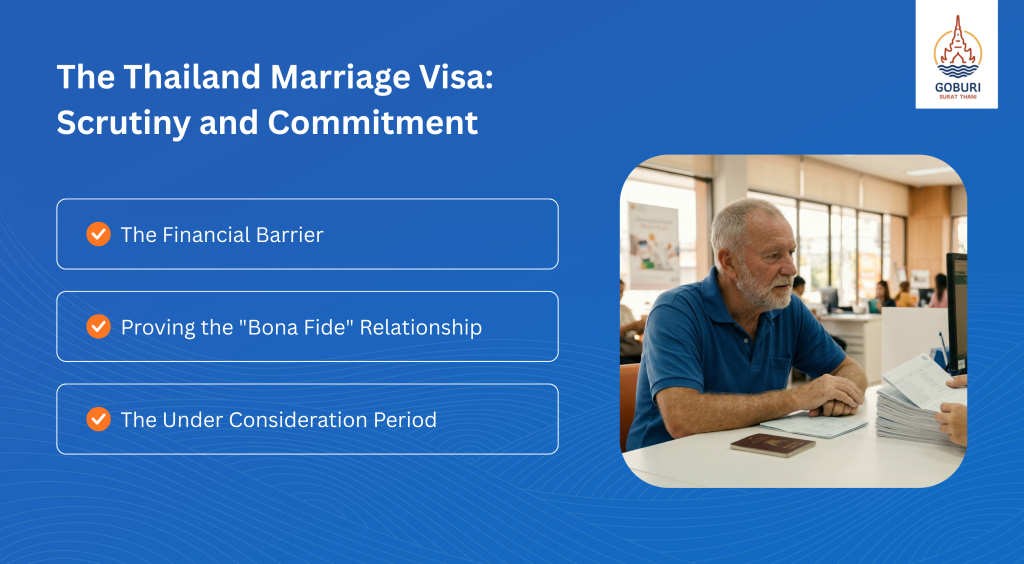
Thai authorities are vigilant against sham marriages. To combat this, they require an extensive photographic portfolio of your life together. You cannot simply provide a few wedding photos. The family visa reality involves submitting color prints of:
The couple standing in front of their home with the house number clearly visible.
The couple inside the home, including the living room and the bedroom.
Contextual evidence of shared life, such as photos in the kitchen or dining area.
A crucial rule is that these photos must be taken by a third party. Selfies are almost universally rejected by immigration officers. This documentation is intended to prove that the couple actually resides together as husband and wife.
For more on how these requirements compare to other options, see our analysis on retirement visas vs reality.
The Under Consideration Period
When you submit your application for a marriage extension, you do not get the one-year stamp immediately. Instead, you receive an “under consideration” stamp, typically valid for 30 days.
During this time, your local immigration office sends your file to a regional headquarters for review. This is also the period when officers may conduct a surprise home visit to interview neighbors and verify your living situation.
If you plan to travel during this month, you must be extremely careful, as a missed home visit can lead to a denial of the extension.
The Thai Child Visa: A Path for Parents
For fathers who have children with a Thai national but are not legally married to the mother, the Thai Child Visa is a vital alternative. However, the legal hurdles here are often higher than the marriage route.
The primary family visa reality for fathers is the requirement for “legitimation.” Under Thai law, a father of a child born out of wedlock does not have automatic parental rights even if his name is on the birth certificate.
He must legally legitimate the child through a court process or a formal registration at the local district office (Amphur). Without this legal standing, the Thai Child Visa application will fail.
The financial requirements for this visa are identical to the marriage visa, requiring a 400,000 THB deposit or a 40,000 THB monthly income. The documentary burden also includes photos of the parent at the child’s school, with the school’s name clearly visible, to prove active involvement in the child’s upbringing.
Many parents fall into the trap of what most foreigners misunderstand by assuming the birth certificate alone is enough to stay forever.
The Guardian Visa: Schooling and Constraints
If you are a foreign family moving to Thailand so your children can attend an international school, the Guardian Visa is the standard path. This is a sub-category of the Non-Immigrant O Visa and is linked to the child’s Education (ED) Visa.
The family visa reality for guardians includes several strict limitations:
The One Parent Rule: Usually, only one parent is granted a Guardian Visa per child. If a family has one child, the other parent must find an alternative visa, such as a retirement or work permit.
Higher Financials: The bank deposit for a Guardian Visa is typically 500,000 THB.
No Work Rights: Unlike the marriage visa, a Guardian Visa does not allow the holder to apply for a work permit or engage in local employment.
This visa is strictly intended for caregiving. If the child’s ED Visa is cancelled or the child leaves the school, the Guardian Visa is immediately terminated. This creates a high-stakes environment where the family’s residency is entirely dependent on the child’s enrollment status.
Marriage Equality and Same-Sex Couples
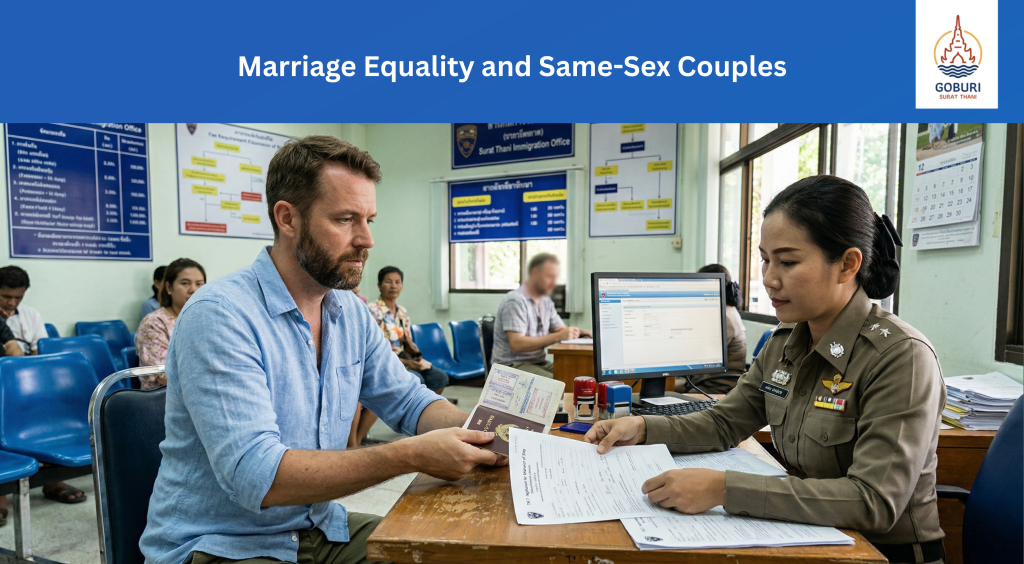
A major shift in the family visa reality occurred with the enactment of the Marriage Equality Act. As of early 2025, same-sex couples can legally register their marriages in Thailand with the same rights as heterosexual couples.
This change has a direct impact on immigration. Same-sex spouses of Thai nationals are now eligible for the Thailand Marriage Visa.
Additionally, same-sex spouses of foreign professionals on long-term visas like the LTR (Long-Term Resident) or DTV (Destination Thailand Visa) can now apply as dependents. This modernization has removed one of the most significant barriers for the LGBTQ+ community living in Thailand, though the financial requirements and documentary scrutiny remain the same for all couples.
The Ongoing Burden of Maintenance
Securing the visa is only half the battle. The family visa reality in Thailand is defined by perpetual administrative maintenance. Failing to keep up with these tasks can lead to fines, blacklisting, or deportation.
90-Day Reporting: The Address Check
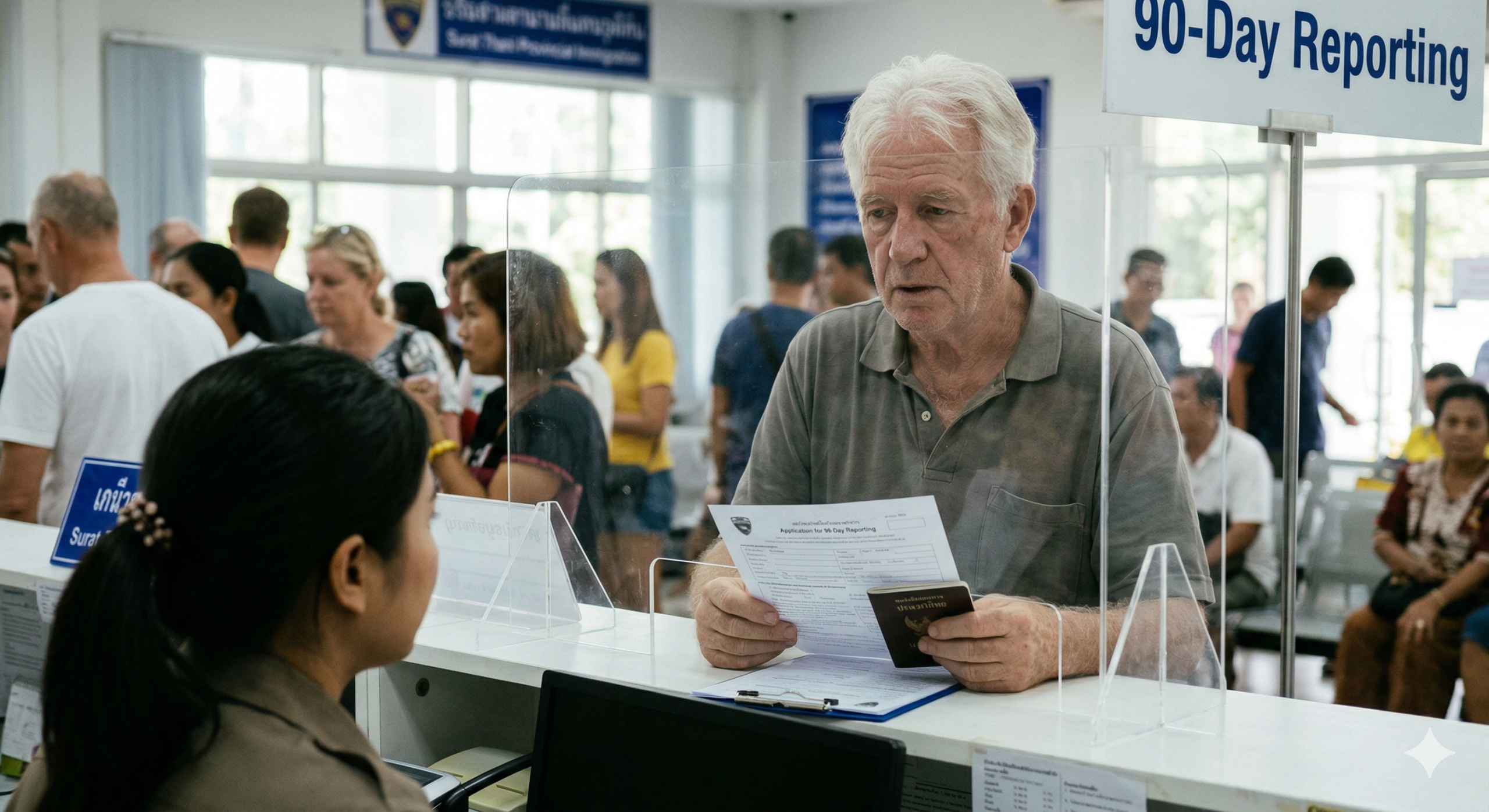
Every foreigner on a long-term extension must perform 90-day reporting. This is not a visa renewal but a simple confirmation of your residential address. You can do this in person, by mail, or through the online portal.
The clock for your 90 days resets every time you enter the country. If you leave Thailand on day 80 and return two weeks later, your next report is due 90 days from the date of your new entry. Missing this deadline results in a 2,000 THB fine, which can rise to 5,000 THB if you are caught during a random police check.
TM30: The Landlord’s Notification
The TM30 form is a notification that a foreigner is staying at a particular property. While the law states that the property owner is responsible for filing this within 24 hours of the foreigner’s arrival, the burden often falls on the foreigner during the visa extension process.
One of the most annoying aspects of the TM30 is that it is easily overridden. If you go to a hotel for a weekend, the hotel will file a TM30 for you.
When you return home, your original home-based TM30 may no longer be the active record in the immigration system. This can cause your online 90-day reporting to be rejected, forcing a trip to the immigration office to correct the record.
Re-entry Permits: Protecting Your Status
Your one-year extension is fragile. If you leave Thailand without a re-entry permit, your visa is automatically cancelled. You must obtain either a single re-entry permit (1,000 THB) or a multiple re-entry permit (3,800 THB) before you depart. You can get these at the immigration office or at the airport before you clear passport control.
Strategic Comparisons: Non-O vs. Other Options
For those who are eligible for multiple visa types, choosing the best one requires an understanding of the trade-offs between financial cost and administrative hassle. This is a core theme in our guide on why visas should not drive location choice.
Marriage Visa vs. Retirement Visa
Foreigners over 50 years of age often choose between the Thailand Marriage Visa and the Retirement Visa (Non-OA/O).
Financials: Retirement requires 800,000 THB, whereas Marriage requires only 400,000 THB.
Hassle: Retirement does not require the spouse’s presence, photos of the bedroom, or home visits.
Work: A Thailand Marriage Visa allows for a work permit, while a Retirement Visa does not.
Many retirees choose to use the Retirement Visa even if they are married, simply to avoid the annual interrogation and the need for their spouse to spend a day at the immigration office.
The Role of the Destination Thailand Visa (DTV)
The newly introduced Destination Thailand Visa (DTV) has changed the landscape for remote workers and those engaging in cultural activities. While it is not a family visa, it allows for a five-year stay with minimal reporting.
For a foreigner married to a Thai but working for a foreign company, the DTV may be a more convenient option than the marriage-based Non-Immigrant O Visa, provided they meet the DTV criteria.
Long-Term Horizons: Permanent Residency and Citizenship
For those who see their future permanently in Thailand, the Thailand Marriage Visa offers a significant advantage in the path toward Thai Citizenship.
The Shortcut to Citizenship
In most cases, a foreigner must hold Permanent Residency (PR) for five years before they can apply for citizenship. However, for a foreign man married to a Thai woman, the PR stage can be skipped. He can apply for Thai Citizenship after three years of consecutive marriage-based extensions, provided he meets the income and tax requirements.
The Integration Test
The reality of this path is that it is not merely a paperwork exercise. It involves:
Interviews at the Ministry of Interior in the Thai language.
Background checks by multiple security agencies.
A point system that rewards those with Thai children, community involvement, and high tax contributions.
While this is the ultimate goal for many, it is a multi-year process that requires a high degree of integration and patience.
Common Pitfalls: Why Applications Fail
The family visa reality is that the Immigration Bureau has total discretion. Even if you meet the checklists, you can be denied for administrative errors or perceived inconsistencies.
E-Visa and Form Entry Errors
The transition to an E-visa system for initial entries has introduced new points of failure. Common mistakes include:
Name Mismatches: The name on the application must perfectly match the Machine Readable Zone (MRZ) at the bottom of the passport. If the passport says Robert and the applicant writes Rob, the application will likely be rejected without a refund.
Character Errors: Mistaking the number 0 for the letter O in the passport number.
Invalid Photos: Using a cropped photo from a passport or a photo that is more than six months old.
The Seasoning Failure
Many foreigners fail to realize that the 400,000 THB must stay in the bank account after the visa is granted. If an officer checks the bank records during a subsequent visit and sees that the balance dropped to 100,000 THB a week after the extension was granted, the foreigner may face a ban or a denial of future extensions. The money is intended as a permanent safety net, not a temporary show of funds.
Securing Your Future: The Final Verdict on Family Residency
Living in Thailand with your family is a rewarding experience, but the administrative framework is designed to verify, not just facilitate. The family visa reality requires you to be part bookkeeper, part archivist, and part diplomat.
By maintaining clear records, meeting financial requirements honestly, and staying ahead of 90-day reporting deadlines, you can navigate the system successfully.
Success in Thailand is not just about having the right visa. It is about aligning your legal status with your actual lifestyle. For a broader look at the visa landscape, visit our pillar page to see how family options fit into the bigger picture.
Whether you are here for marriage, your children’s education, or to support a household, respect for the rules and the culture will ensure that your stay in the Kingdom is stable and long-term.
The reality of residency in Thailand is that it is a partnership between the foreigner and the state. By respecting the regulations and the culture of the Kingdom, you ensure that your stay is not just long term, but also peaceful and legally secure.