Updates from
Goburi Surat Thani

24K subscribers
We occasionally share updates when important information changes or new long-form guides are published. Just practical updates related to long-term living in Surat Thani and Southern Thailand.
You can unsubscribe at any time.

Surat Thani vs Hua Hin

Establishing a long-term base along the Gulf of Thailand requires a transition from travel-based observation to an analysis of provincial infrastructure and economic stability. This comparison evaluates the fundamental trade-offs between two of the region’s most prominent hubs, Surat Thani vs Hua Hin, which offer proximity to the coast and a tropical climate despite having different economic structures.
Surat Thani operates as a mainland logistical engine, serving as the administrative heart for the upper south with an economy anchored in agriculture and regional trade. In contrast, Hua Hin functions as a sophisticated “royal” resort town that balances its identity between a domestic weekend retreat for Bangkok’s upper class and a mature international retirement community. For those still weighing multiple locations across the region, it is helpful to explore our broader Southern Thailand residency and lifestyle comparisons to understand how these hubs fit into the wider provincial landscape.

Demographic and Economic Profiles

Understanding the economic and demographic “why” behind each location explains the practical “how” of daily residency. While both provinces are situated on the Gulf, they operate on different financial and social engines.
The Surat Thani Economy
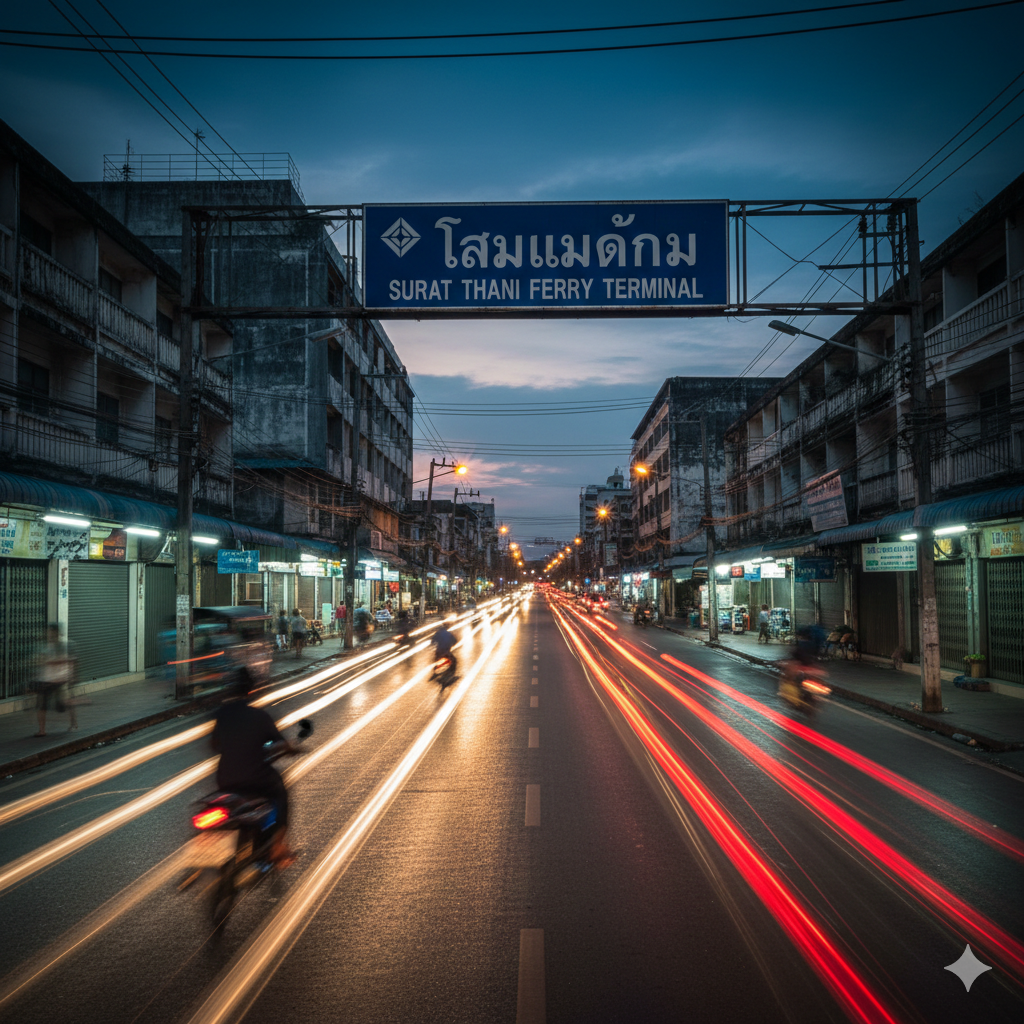
Surat Thani functions as a production-led logistical hub where the economy is anchored in agriculture, maritime trade, and energy rather than seasonal tourism. This industrial foundation provides residents with stable, domestic pricing and a Surat Thani infrastructure built for permanent inhabitants. By operating independently from the nearby Gulf islands, the mainland city remains insulated from “island pricing” and the inflation common in high-traffic tourist zones.
The Hua Hin Economy (The Established Retreat)
Hua Hin’s economy functions as a hybrid of high-end domestic tourism and a mature international real estate market, serving as a primary residence hub for Hua Hin expat residency in 2026. Driven by hospitality, wellness, and retail development, the area offers a high density of Western-standard amenities, including international grocery chains and modern community malls. However, the local economy remains sensitive to Bangkok’s weekend cycles, resulting in predictable peaks in traffic and business activity from Friday through Sunday.

Utilities and Administrative Bureaucracy

For long-term residents, “administrative friction” is a primary factor in quality of life. Dealing with government offices and utility providers differs between a regional capital and a specialized coastal town.
Immigration and Government Services
In 2026, the Destination Thailand Visa (DTV) has become the primary standard for remote professionals, though administrative efficiency varies significantly between regional offices. Hua Hin Immigration is highly experienced with international residents and offers English-centric service, though it faces heavy volume and longer wait times during the “cool season” peak from November to February. Conversely, the Surat Thani office operates in a lower-volume environment where English-language support is less prevalent, but processing speeds for 90-day reporting and address verifications are often superior due to significantly shorter queues.
Utility Management (Electric and Water)
Surat Thani provides superior utility security as the region’s primary source for water and power, allowing residents to pay standard Provincial Electricity Authority (PEA) rates without the private surcharges often found in managed resort complexes. In contrast, while Hua Hin’s infrastructure is robust, the area historically faces water scarcity during extended dry seasons, requiring many modern gated communities to utilize large-scale storage tanks. Consequently, residents in Hua Hin’s private developments should account for slightly higher water costs and the logistical necessity of secondary storage systems as part of their Thailand Gulf Coast relocation planning.

Climate and Seasonality Logistics

The Gulf of Thailand’s weather cycle impacts food supply, transport costs, and daily safety.
Surat Thani Climate and Weather
Surat Thani’s climate is primarily dictated by the Northeast Monsoon, resulting in a concentrated rainy season from October to December. During this period, heavy precipitation can lead to localized flash flooding on major arterial roads, which occasionally disrupts land logistics to the Don Sak ferry piers. Furthermore, the province’s inland geography and proximity to extensive wetlands maintain higher humidity levels year-round compared to the drier, coastal profile of Hua Hin.
Hua Hin Climate and Weather
Hua Hin is frequently recognized for possessing one of Thailand’s most stable microclimates, largely due to a rain shadow effect that results in a primary rainy season during September and October, which is notably shorter than that of provinces further south. This geographic advantage provides residents with a higher average number of sunny days and a lower humidity profile, facilitating a more comfortable environment for consistent outdoor activities such as golf or cycling. However, potential residents should account for the annual “burning season” from January to March, during which air quality can occasionally fluctuate as smoke drifts into the coastal area from neighboring agricultural regions.

Housing and Real Estate:
Value Comparison

Housing represents the largest variable in a monthly budget. In 2026, the market in both areas remains a “buyer’s/renter’s market” compared to Phuket, but at different price points.

Surat Thani Housing

In Surat Thani, the residential real estate market is primarily dictated by local Thai salaries rather than international demand, resulting in detached three-bedroom houses typically ranging from 12,000 to 18,000 THB per month. The local real estate strategy focuses on traditional gated communities, or Moo Bans, which are designed for Thai professionals and offer long-term stability in pricing. Because the city functions as a mainland administrative hub rather than a high-density resort zone, modern high-rise condominiums remain rare in the city center, prioritizing low-rise, family-oriented developments.
who should not move to Surat Thani

Hua Hin Housing (The Lifestyle Choice)

Hua Hin provides a broad spectrum of housing options constructed to international specifications, catering to a diverse expatriate demographic. In popular inland districts such as Soi 88 or Hin Lek Fai, a three-bedroom detached pool villa typically commands a monthly rent between 30,000 and 55,000 THB, while modern one-bedroom condominiums in the city center or near Khao Takiab average between 15,000 and 22,000 THB. Prospective residents should be aware that rental prices here are sensitive to seasonal demand and may be subject to premiums unless secured through a formal 12-month contract, a key consideration for the cost of living in Southern Thailand 2026.

Cultural Life and
Community Events

Social integration depends largely on the community rhythm of a city, which dictates how easily a resident can transition from a spectator to a participant. In 2026, the contrast lies between a mainland southern culture defined by localized religious devotion and a coastal northern scene built on a globalized, event-driven ecosystem.
Surat Thani: The Local Tradition
In Surat Thani, cultural life is defined by community-driven rituals where international residents typically observe authentic Southern Thai traditions rather than commercialized spectacles. The annual Chak Phra Festival serves as a primary example, featuring grand land and water processions to mark the end of Buddhist Lent in an atmosphere of local pride that remains largely free of inflated tourist pricing. This regional identity extends to the city’s daily rhythm, which centers on the Tapi Riverfront and various night markets designed to cater to the local working population rather than a transient holiday demographic.
Hua Hin: The Royal Heritage and Modern Expat Scene
Hua Hin’s culture functions as a sophisticated blend of traditional Thai royalty and modern international influence, creating a social landscape characterized by a dense ecosystem of jazz festivals, professional golf tournaments, and international food fairs. Due to the high density of long-term foreign residents, expatriate integration is notably more accessible than on the mainland, with numerous established community groups, hobby clubs, and English-speaking social circles. This maturity in the local social infrastructure allows for a more immediate transition for those seeking a community that balances Thai heritage with familiar international lifestyle standards.

Infrastructure: Healthcare and Education

The reliability of local support systems often determines the success of a multi-year residency more than a location’s aesthetic appeal. For families and retirees, the choice depends on whether they require a high-density, internationalized service structure or a robust regional system operating at domestic price points.

Medical Facilities

Healthcare infrastructure in 2026 differs significantly between the two hubs; Hua Hin serves as a premier medical destination featuring JCI-accredited care and specialized international coordination at Bangkok Hospital Hua Hin, where multilingual staff and seamless insurance handling cater to a global demographic. Conversely, Surat Thani provides robust regional care through established institutions like Thaksin Hospital, which maintains high clinical expertise within an administrative framework primarily geared toward Thai speakers. While medical standards remain consistent, the mainland system in Surat Thani prioritizes domestic pricing and localized service, making it a pragmatic choice for those comfortable navigating a Thai-centric environment.

who should not move to Surat Thani

Educational Infrastructure for Expatriate Families

Educational infrastructure in 2026 highlights the contrast between premium hubs and cost-effective mainland cities. Hua Hin features elite institutions like Hua Hin International School (HHIS), offering a UK curriculum and IB program with primary tuition starting at approximately 580,000 THB. In contrast, Surat Thani provides more integrated and economical options, such as Daniel International School (DIS), which follows an American-based curriculum. With primary tuition at DIS approximately 334,000 THB, the mainland offers high academic standards and deeper cultural integration at roughly 40% less than Hua Hin’s premium alternatives.

Comparative Data Matrix (The Resident’s View)

Category Surat Thani (Mainland) Hua Hin (Coastal)
Typical Rent (3-Bed House) 12,000 – 18,000 THB 30,000 – 55,000 THB
Traffic Condition Predictable / Low Stress Weekend Congestion (BKK traffic)
Language Barrier High (Thai Required) Low (English Common)
Western Amenities Limited (Big C / Lotus’s) Abundant (Bluport / Market Village)
Public Transit Nil (Car/Bike Dependent) Songthaews & Local Taxis
Healthcare Standard Regional Private (Thai-centric) JCI Accredited (International)

Connectivity and Logistics

While Surat Thani functions as a mainland transit engine connecting the southern provinces to Malaysia, Hua Hin serves as a boutique coastal gateway offering direct, high-speed links to the capital and expanding international flight paths.

Surat Thani: The Regional Transit Hub

Surat Thani Airport (URT) serves as a strategic domestic gateway with high-frequency flights to Bangkok. It is also a major node on the State Railway of Thailand’s southern line, offering a direct rail link to Malaysia.
who should not move to Surat Thani

Hua Hin: The Gateway to the Capital

By April 2026, Hua Hin Airport (HHQ) is scheduled to complete its international certification, allowing direct flights from regional Asian hubs. However, the town’s primary logistical advantage remains its 3-hour road proximity to Bangkok and the recently completed double-track rail line, which has significantly reduced train travel times to the capital.

Which Province Suits Your Long-Term Goals?

Choosing between Surat Thani vs Hua Hin requires deciding between deep cultural immersion with mainland economic stability or the high-convenience, internationalized infrastructure of a premier coastal retreat.
Choose Surat Thani if:
You prioritize cost stability; your budget goes significantly further regarding rent and services.
You prefer a “local-first” environment and want to immerse yourself in Thai culture outside of the major expat zones.
You require a quiet, mainland lifestyle with less emphasis on “resort” amenities.
Choose Hua Hin if:
You require proximity to Bangkok for business or weekend trips.
You prioritize a high density of Western-standard amenities, international schools, and premium healthcare.
You want a mature expat community with diverse social and networking opportunities.