We occasionally share updates when important information changes or new long-form guides are published. Just practical updates related to long-term living in Surat Thani and Southern Thailand.
For families relocating to Southern Thailand, the quality and cost of education are often the deciding factors in choosing a home. While Surat Thani does not have the sheer volume of international schools found in Bangkok or Phuket, it offers a distinct advantage through a significantly lower entry point for high-quality, English-language education.
In this guide, we break down the school costs in Surat Thani for 2026. We look beyond the base tuition to explore the mandatory fees, hidden expenses, and the structural differences between International Schools and English Programs (EP) in local private schools. Our goal is to help you build a realistic education budget that supports long term stability and avoids the sticker shock often associated with moving children between global education systems.
Understanding the Education Landscape in Surat Thani
Surat Thani serves a regional population of Thai professionals and a growing community of long-term expats. Because the market is not purely tourist-driven, school fees are generally pegged to local middle-class affordability. When researching education, you will encounter three primary tiers that cater to different academic goals and budget constraints.
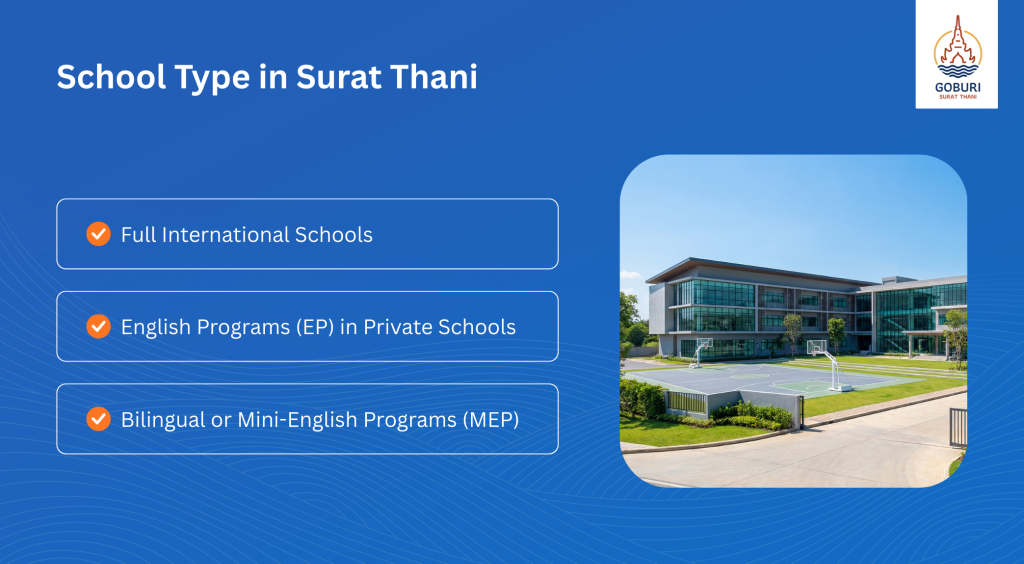
Tier 1: Full International Schools
These institutions represent the highest standard of international schools in Surat Thani tuition and are designed for families who require a globally portable education. These schools typically adopt world-recognized frameworks such as the International Baccalaureate (IB) or the American Common Core State Standards.
The defining characteristic of Tier 1 schools is the faculty composition. You will find that the vast majority of the teaching staff are native English speakers recruited from countries like the United Kingdom, Canada, Australia, and the United States. This ensures not only linguistic immersion but also a Western pedagogical approach that emphasizes critical thinking over rote memorization.
For the 2026 academic year, these schools have heavily invested in specialized facilities like STEAM labs and high-end athletic complexes. While the costs are the highest in the province, the primary value lies in the university placement support. These schools have dedicated counselors who assist students with applications to prestigious universities abroad, making them the logical choice for families who do not plan on their children remaining in the Thai higher education system.
Tier 2: English Programs (EP) in Private Schools
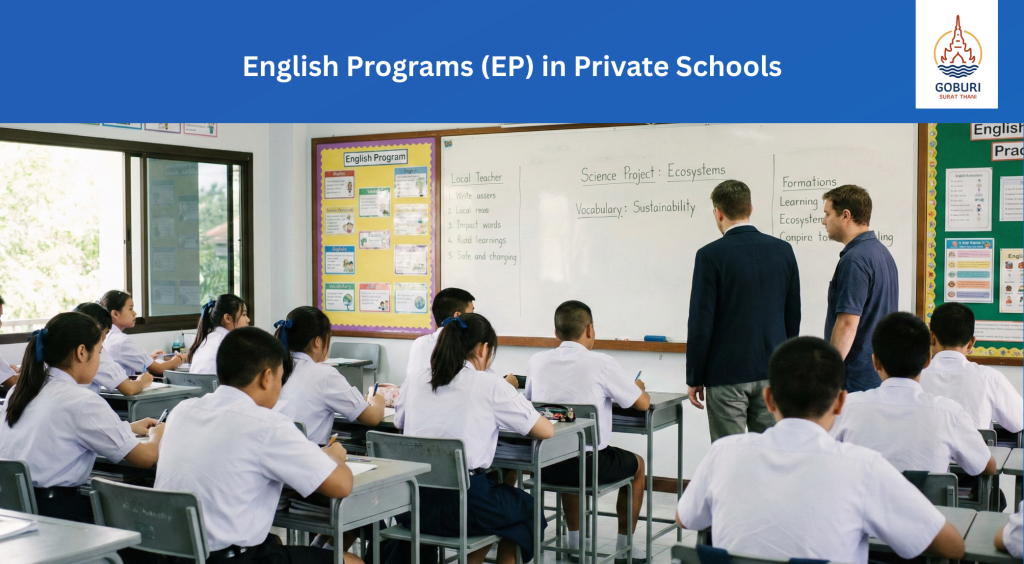
Managed by established and prestigious Thai private schools, English Programs offer a rigorous middle ground. These programs are governed by the Office of the Private Education Commission (OPEC) and follow the Thai National Curriculum, yet they deliver core subjects like Mathematics, Science, and Health in English.
In an EP setting, students spend approximately 60% to 80% of their day learning in English. The teachers are usually a mix of native English speakers and highly qualified non-native speakers from countries like the Philippines or South Africa. This diversity often leads to a more balanced perspective on global education while keeping private school fees in Surat Thani significantly more accessible than full international schools.
The academic environment in Tier 2 schools is often more disciplined and follows traditional Thai values of respect and social hierarchy. This is an excellent option for expat families who want their children to be fully integrated into the local community while maintaining a high enough level of English to transition back to their home country’s school system later in life.
Tier 3: Bilingual or Mini-English Programs (MEP)
Bilingual and Mini-English Programs represent the most entry-level path for English language education on the mainland. These programs are often found in both larger private schools and some specialized government-assisted institutions. They are specifically designed for families who prioritize Thai language fluency or those who are operating on a stricter budget for school costs in Surat Thani.
In an MEP, the English contact hours are reduced to approximately 15 to 20 hours per week. The focus is primarily on English literacy, basic Math, and Science. Most of the social subjects, history, and arts are taught in Thai by local teachers. This creates a unique hybrid environment where children become balanced bilinguals at a very young age.
For 2026, many Tier 3 programs have introduced enhanced digital learning tools to compensate for fewer hours of direct foreign teacher interaction. This tier is particularly well-suited for kindergarten-aged children or early elementary students who are in the absorptive phase of language acquisition. It offers a much more robust academic foundation than standard government schools while keeping the expat education costs in Southern Thailand at their lowest possible baseline.
International School Tuition: The Premium Option
International schools provide the most seamless transition for children coming from Western education systems. In Surat Thani, these institutions are increasingly modernizing their facilities to compete with schools in the capital.
Base Tuition Fee Brackets for 2026
While each school varies, the following ranges represent the standard annual tuition for international standard education in the province for the 2026/2027 academic year.
Grade Level
Annual Tuition (THB)
Annual Tuition (USD approx.)
Kindergarten / Early Years
250,000 to 280,000
$7,100 to $8,000
Elementary (Grades 1 to 5)
330,000 to 360,000
$9,400 to $10,300
Middle School (Grades 6 to 8)
330,000 to 410,000
$9,400 to $11,700
High School (Grades 9 to 12)
415,000 to 550,000+
$11,800 to $15,700+
The One-Time Entry Costs
One of the most overlooked aspects of school costs in Surat Thani is the initial investment required during the first year of enrollment. These fees are almost always non-refundable and must be paid in full before a student starts.
Application and Testing Fee: 5,000 THB. This covers the administrative cost of entrance assessments.
Enrollment / Admission Fee: 50,000 to 100,000 THB. This is a one-time fee to secure the seat. Many schools offer sibling discounts for families enrolling more than one student.
Refundable Security Deposit: 20,000 to 30,000 THB. This is usually returned when the student withdraws, provided that at least one full term of written notice is given.
English Programs (EP): The Value-Driven Alternative
For many expat families, English Programs (EP) in reputable Thai private schools offer the best balance between cost and quality. These programs are designed to offer a rigorous academic environment at a fraction of the cost of full international institutions.
What You Pay for EP
Annual private school fees in Surat Thani for a high-quality English Program typically range from 60,000 to 120,000 THB ($1,700 to $3,400 USD).
Curriculum Structure: While the framework is Thai, the delivery of Science, Math, and English is handled by foreign teachers. This ensures students maintain competitive English levels while gaining a deep understanding of local culture.
Immersion Levels: The student body is predominantly Thai. This provides a much faster immersion into the local language, which is often a priority for families planning to stay for 5 to 10 years.
Accessibility: Most EP schools in Surat Thani are located near the city center or the Makham Tia district, making them easily accessible from popular residential Moo Baans.
Mandatory Hidden Expenses in 2026
When calculating the total expat education costs in Southern Thailand, the base tuition is rarely the final number. To build an accurate budget, you must account for several recurring annual expenses that are standard across all private and international institutions.
1. General and Campus Fees
Most schools charge an annual General Fee ranging from 20,000 to 45,000 THB. This fee covers campus maintenance, basic accident insurance, and access to digital resources.
2. Uniforms and Accessories
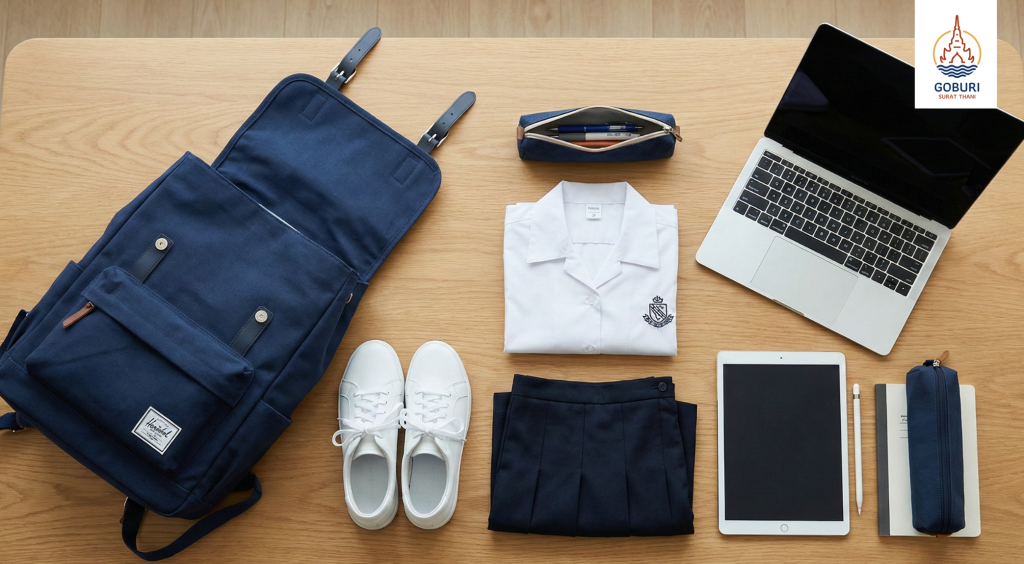
Expat families often underestimate the cost of the tropical school wardrobe. Most schools require:
Formal Uniforms: 2 to 3 sets.
PE Kits: 1 to 2 sets.
Cultural/House Shirts: Often worn on Fridays or during special events.
Initial Cost: Expect to spend 4,000 to 8,000 THB per child in the first year.
3. Lunches and Snacks
In Tier 1 international schools, high-quality lunches and snacks are usually included in the tuition. In Tier 2 EP schools, this may be an optional add-on of 12,000 to 18,000 THB per year.
4. Technology and Materials
Starting in Middle School, many international schools require students to have their own laptop or tablet. Additionally, external examination fees for the Cambridge IGCSE or SAT can add 20,000-40,000 THB in the final years of schooling. Most schools now mandate iPads for Grades 1–4 and MacBooks for Grade 5 and up. This is a specific hardware expense (approx. 30,000–60,000 THB) that families should budget for in the first year.
5. English Language Support (ELS/EAL)
While some schools include basic ESL support in the base tuition, others bill intensive support separately based on the child’s proficiency level.
Level 1 Support: 10,000 THB per term.
Level 3 Support (New to English): Up to 35,000 THB per term.
Regional Comparison: Surat Thani vs. Phuket and Koh Samui
The primary reason families choose Surat Thani is the significant discount on education compared to the nearby islands. While the cost of living in Southern Thailand is generally lower than on the mainland, the gap is most visible in the schooling sector.
Fee Category
Surat Thani (Mainland)
Koh Samui / Phuket
Avg. Elementary Tuition
330,000 THB
480,000 to 750,000 THB
One-Time Admission Fee
50,000 THB
100,000 to 285,000 THB
Waitlist Probability
Low
High
Student-to-Teacher Ratio
15:1
22:1
By choosing the mainland, a family with two children can save upwards of 500,000 THB ($14,000 USD) per year on tuition alone. These savings are often the difference between a family surviving on a single income versus thriving with a significant travel and savings budget. For a broader look at how these savings impact your monthly budget, see our detailed guide on the cost of living in Surat Thani.
Choosing the Right School for Your Budget
Choosing a school is not just a financial decision but a lifestyle one. Before committing to the school costs in Surat Thani, consider these three grounded tips to ensure your investment is protected.
1. The Tuesday Morning Visit
Do not rely on polished weekend tours. Request a visit on a Tuesday or Wednesday morning at 10:00 AM. This allows you to see the actual interaction between teachers and students. Observe the vibe of the school to see if it is calm and productive. Are the science labs and ICT studios actually being used, or are they just showpieces?
2. Verify Teacher Tenure
High staff turnover is a common issue in lower-tier international schools. Ask the admissions officer about the average length of stay for their foreign teaching staff. For a stable education, you want a school where the core teachers have been in place for at least three years. Frequent teacher changes can disrupt a child’s academic progress and emotional stability.
3. The Residential Trip Audit
Ask for a 3-year history of extra costs. Some schools mandate annual residential trips (overnight camps) that can cost between 10,000 and 25,000 THB, depending on the destination. These are rarely listed in the main tuition table but are mandatory for graduation or progression in certain grades.
Navigating the Enrollment Process
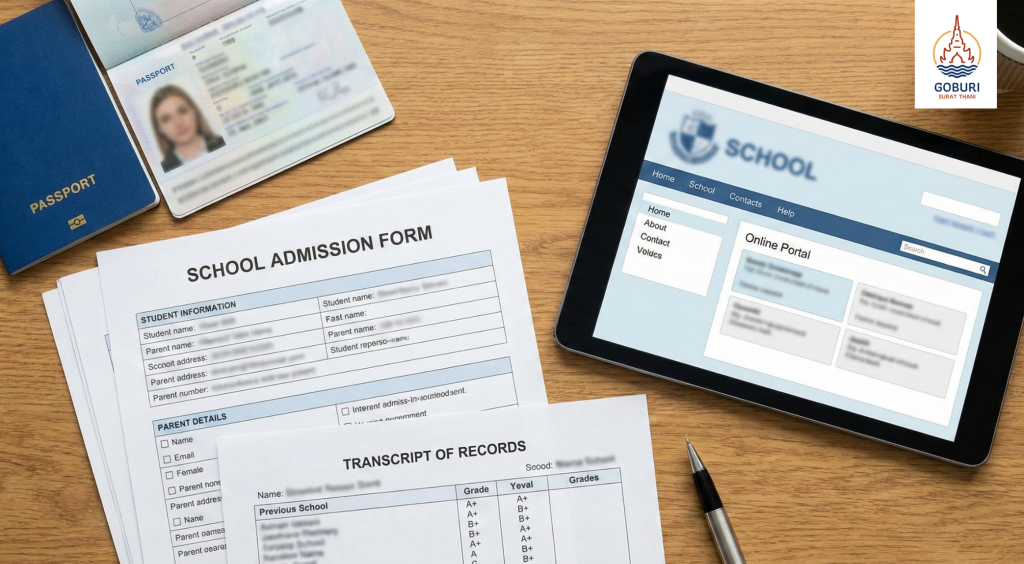
Once you have identified a school that fits your budget for private school feesin Surat Thani, the enrollment process typically follows a standard path. Being prepared with the right documentation can save you weeks of administrative delays.
Documentation Requirements
To enroll in a Thai private or international school, you will typically need:
Original birth certificates with certified English translations if necessary.
The last two years of school reports or transcripts.
Vaccination records.
Parent and student passports with valid visas. Education Visa support is usually provided by the school after the deposit is paid. You can review the official requirements for the Thai Education Visa online.
The Placement Test
Most schools require a placement test in English and Mathematics. For international schools, this is less about passing and more about ensuring the child is placed in the correct year group and level of English support.
Final Considerations on Education Costs
The school costs in Surat Thani offer an excellent value proposition for families who want a Western standard education without the hyper-inflated prices of Bangkok or the islands. Whether you choose a top-tier international school or a high-performing English Program, your resources will go much further on the mainland.
However, remember that education is a long-term commitment. Ensure your chosen path is sustainable not just for the first year but for the next five years. Surat Thani provides the financial breathing room to make that possible, which allows you to focus on family life rather than tuition stress.